Famous Christian philosopher and apologist William Lane Craig says in a recent video that he neither affirms nor denies the eternal generation of the Son. Without denying it, he says he does not “confess” it, despite its affirmation by the Nicene Creed. “Begotten” in his mind only refers to Christ’s human nature. Craig is being accused of being a heretic for this. Is it a fair accusation?
Sometimes Bill is too smart for his own good.
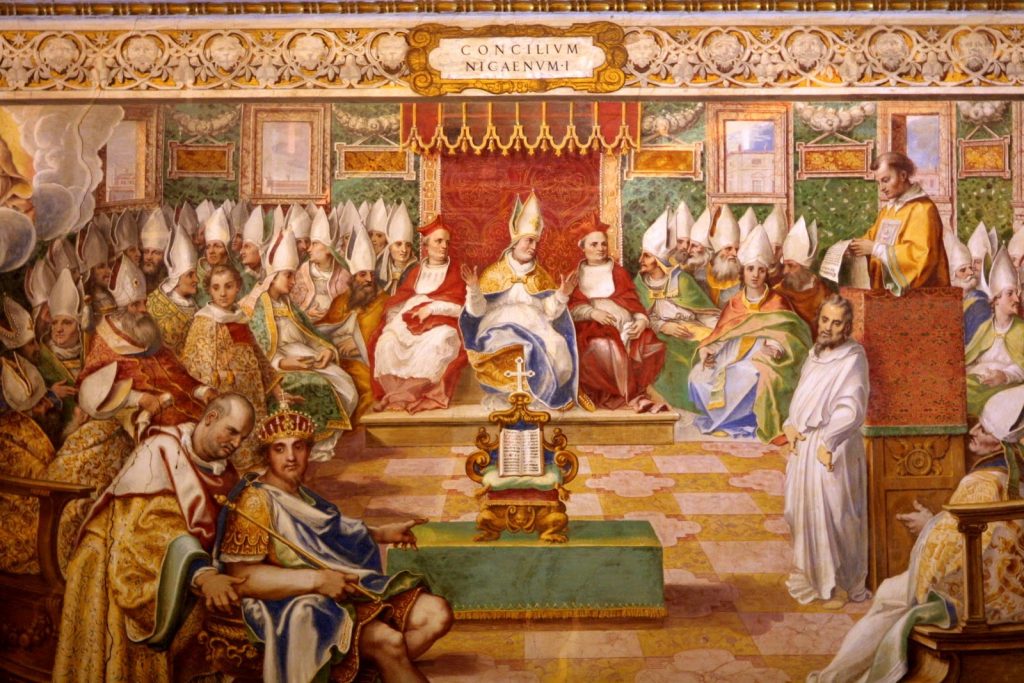 The Nicene Fathers Disagreeing with William Lane Craig
Craig admits the pre-existence of the Son, so why does he resist His eternal generation? Because of some scholarship on John’s Gospel that denies its relevance to the question. There is a reluctance to affirm an advanced Christology in the First Century; it must have evolved slowly. So when John speaks of the Son being “begotten,” he is only referring to His human nature. Craig, in my view, is far too impressed by that reasoning. Surely the terminology evolved, but the scholarship he references seems to me to be tainted by unbelief.
Why do I say that? Well, what does John say in the prologue to his Gospel? The Logos was with God and was God. In 1:1, John is clearly not talking about the incarnation but about the eternal nature of the Son. That is the context for the first use of “begotten” in verse 14. It is true that by the time we get to verse 14 he is introducing the incarnation. But the incarnation is quite specifically the incarnation of One whose begottenness is explicitly tied to the glory of the Father. This tells us that John 1:1 is still in play. Jesus’ human nature was not in itself glorious; it was that of One who in Isaiah 53 has no form or comeliness that we should desire him. Glory in 1:14, then, reaches us back to 1:1 and the Son’s eternal nature: That is the One who is being incarnated in verse 14. Limiting the reference of “begotten” to Christ’s human nature therefore simply won’t fly in the flow of John’s prologue. I can see no reason to deny this conclusion other than a simple unwillingness to allow that legitimate antecedents of the highest Nicene and Chalcedonian Christology were there in God’s revelation about His Son from the beginning—or too much willingness to be influenced by those that are unwilling.
Conclusion: the Logos-Christology Fathers and the Nicene Fathers who followed them got it right.
Is Craig then a heretic? He still affirms the deity and the pre-existence of Christ, so maybe not, at least not technically. But he is playing at brinksmanship with heresy for no good reason other than a desire to appear more biblical than the Nicene Fathers (and the Apostle John!). Too smart for one’s own good sometimes is in effect no different from dumb.
My old seminary classmate has done lots of good work that I continue to appreciate, admire, and use. But he can remind me of that infamous little girl who had the little curl right in the middle of her forehead: When he is good, he is very, very good. But when he is bad, he is horrid!
Donald T. Williams, PhD, is Professor Emeritus of The University of Toccoa Falls. A border dweller, he stays permanently camped out on the borders between serious scholarship and pastoral ministry, theology and literature, Narnia and Middle-earth. He is the author of sixteen books including Credo: Meditations on the Nicene Creed, 2md ed. *Middletown, RI: Stone Tower Press, 2025) and The Devil’s Dictionary of the Christian Church, 2nd ed. (Middletown, RI: Stone Tower Press, 2026).
Related