THE ARREST OF JESUS
Luke 22:47-53
A sermon preached at Trinity Fellowship, Toccoa, GA,3/3/96, and at University Church, Athens, GA, 7/30/23.
Luke 22:47 While he was still speaking, a multitude came, and the one called Judas, one of the twelve, was preceding them. And he approached Jesus to kiss him. 48 And Jesus said to him, “Judas, are you betraying the Son of Man with a kiss?” 49 And when those who were around him saw what was going to happen, they said, “Lord, shall we strike with the sword?” 50 And a certain one of them struck the slave of the high priest and cut off his right ear. 51 But Jesus answered and said, “Stop! No more of this.” And he touched his ear and healed him. 52 And Jesus said to the chief priests and officers of the temple and elders who had come against him, “Have you come out with swords and clubs as against a robber? 53 While I was with you daily in the temple, you did not lay hands on me. But this hour and the power of darkness is yours.”

INTRODUCTION: Of twenty-four chapters in his Gospel, Luke devotes twenty-two to the last three years of Jesus’ life. Of those twenty-two, five and a half are devoted to the last week of it and the forty days that followed that. Of 1, 151 verses, 268 are devoted to the one week between the Triumphal Entry and the Resurrection. In other words, twenty three percent of the book is devoted to less than one percent of the time Jesus spent in public ministry, to .0005 of his life. This ratio is similar to that in the other Gospels, and it points out the supreme importance of these events that we are covering in these last few messages. We will therefore look at each episode in some detail, starting with the one we have before us today, the arrest of Jesus. In this account of that gross miscarriage of justice, I would like to highlight three points that are not necessarily related conceptually. I confess that, for once, my points are related only by alliteration and their near simultaneity of occurrence as parts of this episode. But they are all important parts of it which need to be considered. They are The Perfidious Kiss, the Petrine Cut, and the Power of the Curse.
- THE PERFIDIOUS KISS (vs. 48)
We start in verse 48 with the Perfidious Kiss. And Jesus said to him, “Judas, are you betraying the Son of Man with a kiss?” I want to preface my remarks about this verse by reminding you of am important bit of theology: the reality of the incarnation of our Lord. Jesus was God. He was the same person as the eternal Logos, the Second Person of the Trinity. At every moment of eternity and at every moment (save one) of his earthly life, He enjoyed perfect communion with the Father. By that personal connection to the Godhead He still possessed all the attributes of God, including omniscience. But for the sake of our redemption, He had also taken on human nature, and that human nature was also absolutely real. So the divine Person emptied Himself of His glory and His prerogatives and identified Himself with us so closely that He normally limited himself to operating through that finite human nature. As a result of His self-discipline in that ongoing self-sacrifice, He really experienced our life as we live it. He never cheated, as it were, by using His divine power to make His earthly life easier. Do you remember the Temptation, when He refused to turn stones into bread even though he was practically starving after forty days and forty nights of fasting? The bottom line of that discipline is one of the most incomprehensibly astounding facts about Him. It is incomprehensibly astounding, and it is absolutely essential to our redemption: As a result of His incarnation, the totally self-sufficient One could get hungry; the omnipotent One could get tired; and the living God could die.
One further implication is particularly pertinent here: The constant experience of omniscience is part of the glory that our Lord laid aside in order to come to us and identify himself with us as our Head, our Lord, our Substitute, and our Savior. As God he still had omniscience—the Father could give him any information he needed to pursue his ministry. But he normally limited himself to operating through the few paltry million neurons of the finite human brain that came with the very human man Jesus of Nazareth. You see this clearly in Matthew 24:36. Speaking of his Second Coming, Jesus said, “Of that day and hour no one knows, not even the angels in heaven, nor the Son, but only the Father.” How could the divine and therefore omniscient Son not know this? Because there was only room for a finite amount of knowledge in the finite human brain He was using. The day and hour of the Second Coming was on a “need-to-know” basis, and He didn’t need to know. (Neither, apparently, do His disciples, despite the rather arrogant and disobedient attempts by many of them to figure it out.) My point in this long theological digression is to bring into focus one of the strange paradoxes of the divine-human Messiah. Jesus (in one sense) knew everything, but he was capable of being surprised.
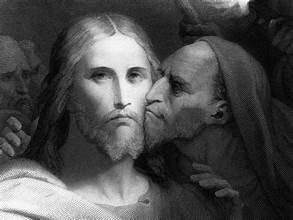
And that is part of what makes this the unkindest kiss on record. The word order in the Greek of verse 48 puts a strong emphasis on the word “kiss.” “Iouda, philemati ton huion tou anthropou paradidos?” “Judas. . . with a KISS you betray the Son of Man?” Jesus knew that Judas was going to be the betrayer, but He was not expecting the method to be so cruel as this. He loved Judas; Judas was one of his closest friends. He knew that Judas had been driven to this action, perhaps by disillusionment over Jesus’ failure to be the military messiah everyone was expecting. But Jesus was affected by the level of brazen hypocrisy of that kiss; He was shocked and hurt by the meaning behind that kiss. This kiss cut deep. It was worse than He expected.
The words still echo through history. “Et tu, Brute? Then fall, Caesar!” “Judas . . . with a KISS?” No one has captured it better than Michael Card:
Why did it have to be a friend who chose to betray the Lord?
And why did he do it with a kiss? That’s not what a kiss is for.
Only a friend betrays a friend; a stranger has naught to gain.
And only a friend comes close enough to ever cause so much pain.
“Et tu, Brute?” “Judas . . . with a KISS?” It was 1986. I had just resigned from my pastorate in Marietta, Georgia, because the Board had refused to back me in a matter of church discipline that was biblically required of us. As a reward for my integrity, I was out of work for a year, put on the shelf. It felt like I had been abandoned. “Lord, I really could have used some backup!” The worst part was the way I had been betrayed by a man on that Board that I had thought was my friend. He had been telling me, “Yes, we need to do this. I’ve got your back!” I will never forget that crucial moment at the Board meeting when instead of backing me up, he just lowered his head and refused to make eye contact. It’s been thirty-seven years now, and I think I’ve gotten over it, until something reminds me and that knife-wound in my back suddenly cuts as sharply and aches as badly as it did when it was fresh.
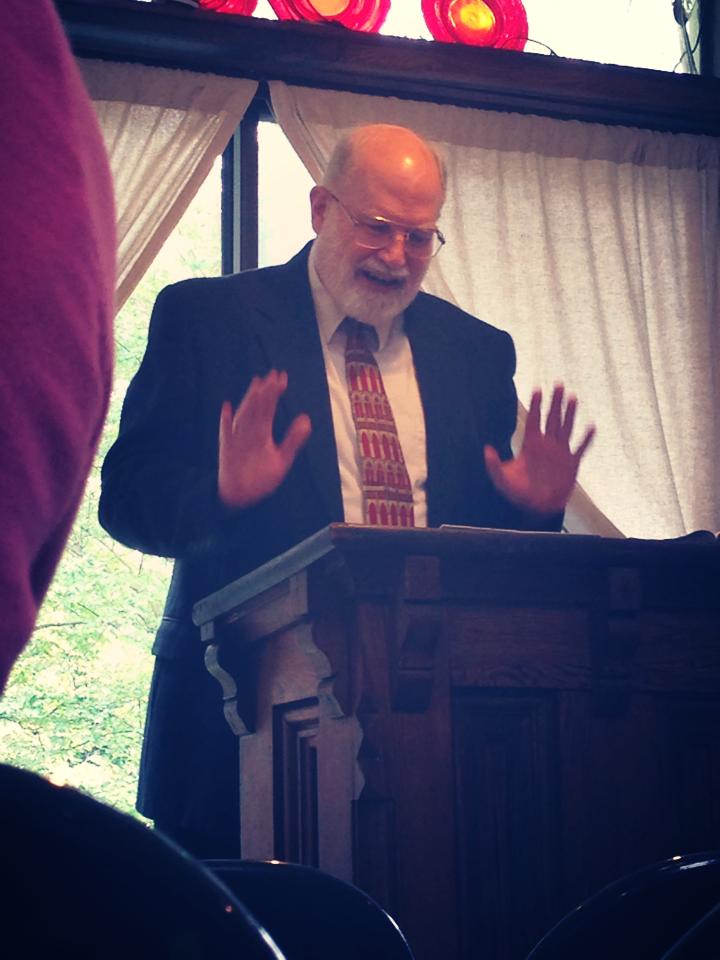 Dr. Williams Preaching at University Church
It was the most depressing period of my life. I questioned my calling and my very identity. It was hard not to feel betrayed by God, not just by Andy. But I doggedly kept reading my Bible and praying, though I was not feeling any comfort from it. Then, at my lowest, I happened to come to this passage as I was having my devotions as is my custom in the Greek New Testament. And I saw for the first time the emphasis on that word. “Judas—with a KISS?” And I broke down and wept like a baby. “Oh, my goodness!” I sobbed. “Now I get it. You went through that for me!” I simply pause on it for a moment once again today as one small insight into the sufferings of Jesus Christ for our redemption.
- THE PETRINE CUT (vss. 49-51)
So the first thing we notice is the Perfidious Kiss. Everything else in the sermon is probably going to seem anticlimactic after that. Forgive me. It needs to be covered. The first thing we notice is the Perfidious Kiss. The next is the Petrine Cut. And when those who were around him saw what was going to happen, they said, “Lord, shall we strike with the sword?” And a certain one of them struck the slave of the high priest and cut off his right ear. But Jesus answered and said, “Stop! No more of this.” And he touched his ear and healed him (verses 49-51). We know from John’s account (18:10) that the impetuous disciple who drew his sword was our old friend Simon Peter Surprise, surprise! What impresses me here is the astounding level of his gross misunderstanding of the situation. We have already seen a couple of weeks ago that he missed the point of Jesus’ advice to sell your cloak and buy a sword. No doubt he was one of the two who pulled theirs out then to show they were ahead of the curve. The sadness in Jesus’ sigh, “It is enough,” went right over his head.
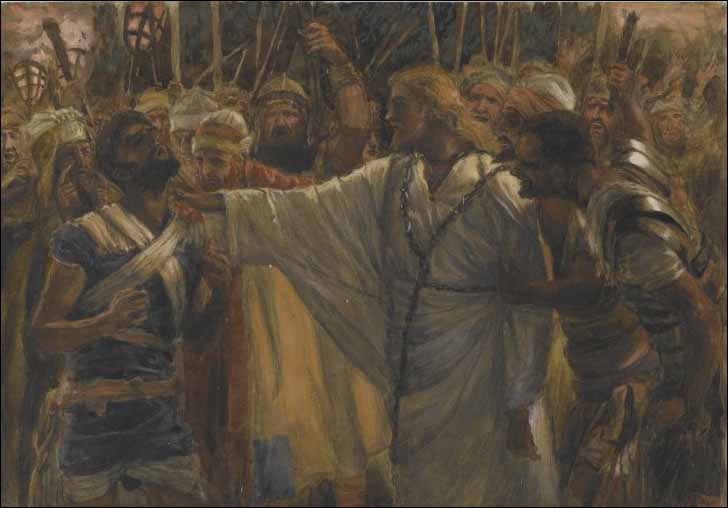
But that was not the only thing that had gone over his head! After all this time Peter was still looking for a military Messiah to overthrow the Roman oppressor. After all this time he still did not realize that Jesus had come to die a sacrificial death for sin. He did not understand that, because Jesus was the innocent Lamb of God, it was important that it be plain that his trial was irregular and unjust. Therefore, Peter almost blew it by giving the temple officials a legitimate excuse for arresting Jesus. He was not a very good swordsman. No doubt, his blow was intended not just to cut off the servant’s ear, but to cleave his skull. Give me Aragorn and Gimli at my side, not Peter, if I ever have to go up against any orcs! But despite the incompetence of His disciple in using both the physical and the spiritual sword, Jesus stayed in control of the situation. He rebuked Peter and healed the ear (so much for a legitimate excuse to arrest Him), and things proceeded according to the Father’s plan after all.
Peter’s stroke here shows us something we have noted before in these studies: the power for evil of preconceived notions. Just think of what Peter had heard that should have told him different; listen just to a part, from Luke’s account, of what he had managed to miss, reinterpret, or ignore. “The Son of Man must suffer many things and be rejected by the elders and chief priest and scribes, and be killed, and be raised up on the third day” (Luke 9:22). On the Mount of Transfiguration, he had heard Moses and Elijah talking with Jesus about “his departure [Greek, exodus] which he was about to accomplish in Jerusalem” (9:31). “Let these words sink into your ears, for the Son of Man is going to be delivered into the hands of men” (9:44). “Whoever does not carry his own cross cannot come after me and be my disciple” (14:27). The Son of Man will come in power and glory, “But first he must suffer many things and be rejected by this generation” (17:25). “And he took the twelve aside and said to them, ‘Behold, we are going up to Jerusalem, and all things which are written through the prophets about the Son of Man will be accomplished. For he will be delivered to the Gentiles and will be mocked and mistreated and spat upon, and after they have scourged him, they will kill him; and the third day he will rise again’” (18:31-33). “But when the vine growers saw him, they reasoned among themselves, saying, ‘This is the heir; let us kill him that the inheritance may be ours’” (20:14). “And in the same way he took the cup, saying, ‘This cup which is poured out for you is the New Covenant in my blood’” (22:10). “For I tell you that this which is written about me must be fulfilled, ‘He was numbered among the transgressors’” (22:37).
This teaching was brutal in its bluntness; it was incisive in its clarity; it was unparalleled in its authority; it was more than sufficient in its quantity, indeed abundant to the point of tedium in its repetitions. Yet Peter not only missed it, but he was so far out of harmony with the Lord’s real purpose that his zeal served only to threaten to wreck God’s plan for our redemption. How clueless can you be? Well, when we were natural men and women, we were just as bad. “For the natural man receives not the things of the Spirit of God, neither can he know them, for they are spiritually discerned” (1 Cor. 2:14).
What are the lessons we should take away from this near fiasco? Sincerity is not enough; zeal is not enough; good intentions are not enough. A sound and accurate understanding of biblical doctrine is absolutely essential equipment for Christian service and faithful discipleship. Judas with evil intentions betrayed Jesus with an insincere act of love. Peter with the noblest of intentions almost betrayed him with an ignorant act of war. And if we are not grounded in sound doctrine, we are capable of doing exactly the same thing.
Let us then beware lest our own assumptions cheat us of the truth of Scripture! My experience as a preacher tells me that the people of God have an almost infinite capacity to listen to the Word of God read and expounded without hearing a single solitary thing they do not already believe. It never even occurred to Peter that his assumptions might be wrong! Has it occurred to you? Let us begin with an awareness of the problem. That, combined with a sincere love of God’s truth, unmerciful honesty with ourselves as we read and hear, and conscious dependence on the Holy Spirit, is half the battle.
- THE POWER OF THE CURSE (vs. 53)
So there was a Perfidious Kiss; there was a Petrine Cut; and finally there is the Power of the Curse. And Jesus said to the chief priests and officers of the temple and elders who had come against him, “Have you come out with swords and clubs as against a robber? While I was with you daily in the temple, you did not lay hands on me. But this hour and the power of darkness is yours” (verses 52-3).These are among the most mysterious and chilling words ever spoken: “The hour is yours, and the power of darkness.” Evil is about to do its worst, and that worst—the torture and murder of God—is a horrible thing to contemplate. The power of darkness refers to human nature in its typical depravity and degradation egged on by a power literally diabolical. It is not a pretty picture. This was something that human nature did. Our human nature. Therefore, we must presume that we, apart from grace—you and I, had we been there—would rather brutalize an innocent man who had spent the last three years doing nothing but good to the undeserving than let Him challenge our preconceived notions and our comfortable status quo. And this hour was given to us for that purpose so that, while we were yet sinners, Christ could die for us.
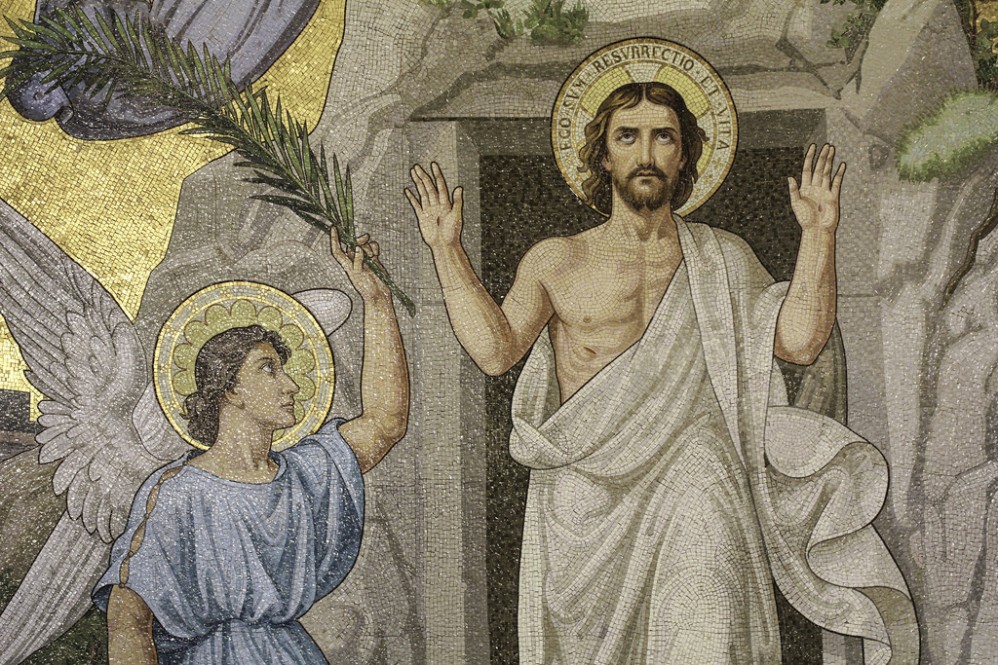 A Different Hour than This One
Yet even in these most chilling of words are hidden the seeds of hope. “This hour is yours,” Jesus says to the mob. This hour; not every hour. As James R. Edwards puts it, “The ‘hour’ has arrived when these climactic forces conspire against Jesus. They are free to kill God’s Son and Servant—and they will—but they are not free to determine the consequences” Norval Geldenhuys says, “In that hour the evil powers of darkness, Satan and his henchman (men and spirits alike) are being permitted by God to bring the Son of the Highest down into the grip of humiliation, suffering, and death—not because He is not mighty enough to prevent all this, but because He voluntarily delivers Himself to be sacrificed for the salvation of guilty mankind”
Again: This hour, Jesus said. Not every hour; not the hour of sunrise on the third day after the Crucifixion. Not any hour after that! The Evil Power in the universe was strong enough to kill the Son of God. But it was not strong enough to prevent His resurrection! J. C. Ryle sums it up well: “Our Lord’s enemies could not take and slay Him until the appointed ‘hour’ of His weakness arrived. Nor yet could they prevent His rising again. . . . When He was led forth to Calvary, it was ‘their hour.’ When He rose victorious from the grave, it was His”
And because He rose victorious, now every hour is His forevermore. And that includes this hour. It includes the darkest hour you have ever known; it includes the darkest hour you have coming. If we belong to Him, it is the same in our lives. If you are a Christian, the power of darkness may be given an hour in your life. But God reserves eternity for himself! Because Christ rose victorious, in Him we will too—even over death. And if over death, then certainly in Christ you can rise over whatever you are struggling with in this hour of your life. That hour belonged to the mob and to the power of darkness. This one, and every other one that will ever come, belongs to Jesus.
CONCLUSION: Remembering the Perfidious Kiss and the Petrine Cut, then, let us beware of betraying the Lord who endured so much for us. Judas did so intentionally by his nefarious treachery. Peter almost did so unintentionally by his impetuous stupidity. And remembering the Power of the Curse and how it was overcome, let us realize that by God’s grace we need do neither, if we cling to this One who was so faithful to us. As we receive Communion today, let us renew our vows of faithfulness to him in the light of these great truths..
Here endeth the Lesson.
Donald T. Williams, PhD, is Professor Emeritus of Toccoa Falls College, an ordained minister in the Evangelical Free Church of America, and a member of University Church, Athens, GA. A border dweller, he stays permanently camped out on the borders between serious scholarship and pastoral ministry, theology and literature, Narnia and Middle-Earth. He is the author of fourteen books, including Ninety-Five Theses for a New Reformation: A Road Map for Post-Evangelical Christianity (Toccoa: Semper Reformanda Publications, 2021) and Answers from Aslan: The Winsome Apologetic of C. S. Lewis (Tampa: DeWard, forthcoming October 2023).
Related