It did not bother me when I read
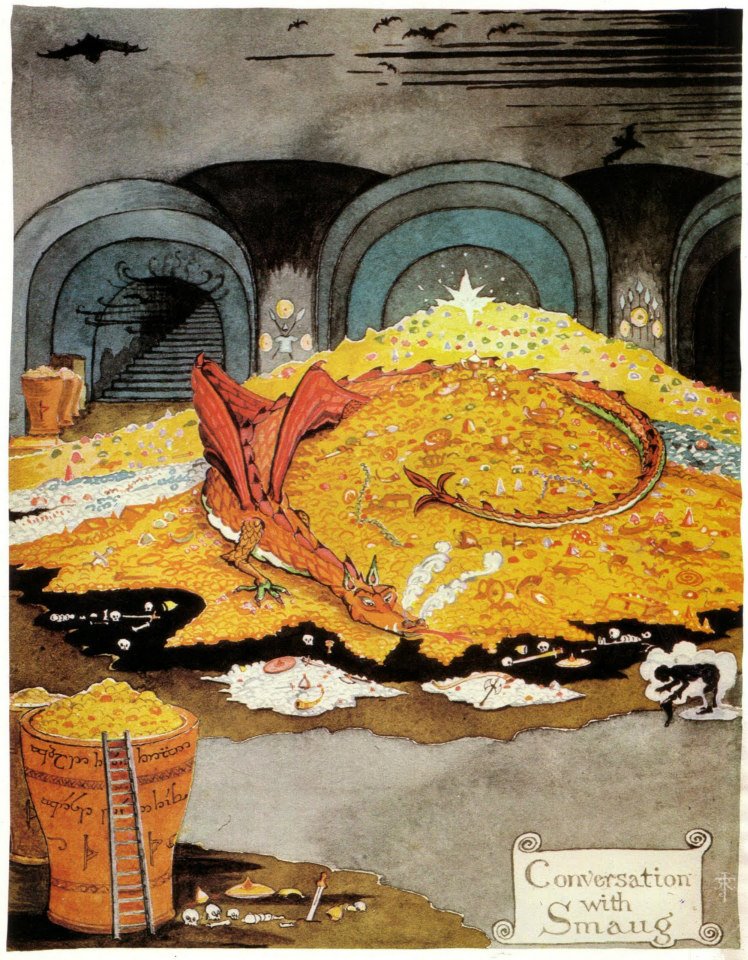
The Hobbit at first, but in subsequent readings I began to have a nagging doubt. What could possibly have made Gandalf think sending thirteen Dwarves and a Hobbit against a dragon could possibly lead to anything but disaster? What made anyone think that burglary was going to produce any effect other than it did—devastation for Lake Town and most likely for Thorin’s company as well? Nobody could have predicted Bilbo’s finding Smaug’s unprotected soft spot, or that the Thrush would be there to tell Bard about it. How is Gandalf’s plan anything more than just irresponsibly poking a hornet’s nest in the insane hope that something good would somehow come of it?
I don’t think there is an answer to this problem in The Hobbit itself. Only reading The Lord of the Rings in the light of The Silmarillion helps me to come to grips with it. For the same pattern plays out there, with Gandalf sending two tomfool Hobbits into Mordor with the Ring. But there we see that, as a servant of the Secret Fire, Gandalf has insight into the will of Iluvatar that enables him to take risks that would otherwise be every bit as insane as Denethor thinks them. Gandalf does not foresee exactly how it is going to work, but he knows that Bilbo was meant to find the Ring and that this is an encouraging thought, and his heart tells him that Gollum has yet a role to play, for good or ill, and that Frodo’s mercy will rule the fate of many.
How does Gandalf have such insight, and how can he trust it? Because as the Maia Olorin he was present at the Great Music, because he knows and trusts Iluvatar, he is able to set in motion processes that he himself does not fully understand and whose outcomes he cannot personally guarantee. In the biblical phrase, he walks by faith and not by sight. It is not a blind faith: It is based on an understanding of who Iluvatar is which, combined with his memory of the Great Music, assures him that the Final Chord, the ultimate Resolution, is coming. But it is faith and not sight for all that.
In The Hobbit we do not see the clues and the reasoning about them that underlie Gandalf’s confidence the way we do in the Trilogy. But having seen it in the Trilogy, we can believe that something adequate was there all those years earlier. Like Gandalf, we too as readers must walk by faith and not by sight.
Donald T. Williams, PhD, is Professor Emeritus of Toccoa Falls College, an ordained minister in the Evangelical Free Church of America, and a member of University Church, Athens, GA. A border dweller, he stays permanently camped out on the borders between serious scholarship and pastoral ministry, theology and literature, Narnia and Middle-Earth. He is the author of fourteen books, including Ninety-Five Theses for a New Reformation: A Road Map for Post-Evangelical Christianity (Toccoa: Semper Reformanda Publications, 2021) and Answers from Aslan: The Winsome Apologetic of C. S. Lewis (Tampa: DeWard, forthcoming summer 2023).
Related