I
When Aaron made the golden calf, he proclaimed a feast to Jehovah. (When LORD is in all caps in your English Bible, it indicates not Adonai but Jehovah in the original Hebrew).
In other words, the Israelites in their idolatry did not think of themselves as forsaking the true God for a pagan god. But they were worshipping Him as if He *were* a pagan god. Their preconceived notions picked up from the surrounding culture created a blind spot that made God’s revelation at Sinai go right over their heads. As a result, their worship of Jehovah was corrupted by paganism, and they were too blind to see it. (And as far as God was concerned, it counted as idolatry, just as if they had consciously been worshipping Baal or Moloch.)
Their experience raises a question for us: How far is our worship corrupted by Neo-Paganism, Secularism, and/or Post-Modernism? Are we willing to pray seriously that God would show us the answer to that question?
II
The scientists of Brobdingnag in their language called Gulliver a “relplum scalcath,” i,e, “something which could not be produced according to the regular laws of nature,” and which therefore cannot possibly exist, even though it is standing right in front of them. Gulliver himself, stubbornly standing there, should have been the only argument needed for the absurdity of their classification.
Are there equivalents in contemporary scientific discourse? E.g., maybe those who are in denial about the massive evidence for intelligent design and fine tuning? About the humanity of the foetus?
These questions I would offer for the enlightenment of scholars and the edification of mankind–were such a thing possible.
III
When our spiritual ancestors in the First Great Awakening spoke of “heart religion,” this is what they meant:
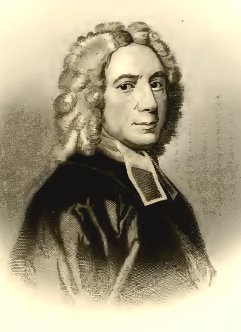 Isaac Watts
“The emotions were made to be servants of reason, to be governed by the judgment, and to be influenced by truth. . . . Those Christians are best prepared for the useful and pious exercises of their emotions who have laid the foundations in an ordered knowledge of the things of God.” — Isaac Watts
IV
“Blessed be the God and Father of our Lord Jesus Christ, the Father of mercies and God of all comfort, who comforts us in all our affliction so that we will be able to comfort those who are in any affliction with the comfort with which we ourselves are comforted by God” (2 Cor. 1:3-4).
We tend to make the suffering that God allows in our lives self-referential: There must be some sin we are being chastised for, some lack of faith on our part, or some lesson God needs to teach us. Those explanations are possible, of course; they are quite often indeed what it happening. But it may simply be that God does not exempt us from experiencing the consequences of living in a fallen world. Why not? Because the Father wants us to be able to relate to, empathize with, and identify with others who are victims of the Fall. And if we were isolated from those effects, how could we do so with any credibility? He does not promise to insulate us from suffering, but to sustain and comfort us in it.
Maybe your suffering isn’t about you at all; maybe it is about someone else you will be uniquely qualified to help only because of it. If we can accept this opportunity as the privilege it is, it is in itself the greatest comfort in our own suffering we can have–because it gives us the privilege of following in the footsteps of Christ.
V
At the time of the Reformation, the modern concept of the separation of church and state had not yet entered anyone’s mind. All secular rulers assumed that a cohesive society could not exist without religious unity and that it was their responsibility to provide it by choosing the true church and imposing it on the people by law.
Nobody here thinks they chose the right method; but were they wrong about the goal? The results of unchecked pluralism in our own society make me wonder. But a state church is not the answer. It only encourages formalism and hypocrisy. History shows plainly that it does more harm than good.
Conservative Christians are right to think that our democracy can only survive if the old ‘Christian consensus’ is restored. But some of them are wrong when they act as if they thought that task could be accomplished through politics directly. Politics is downstream from culture, and culture is downstream from religion. Therefore, it has to be done the old-fashioned way, through evangelism and discipleship.
And I don’t know that we are serious enough for that yet!
Donald T. Williams, PhD, is Professor Emeritus of Toccoa Falls College. A border dweller, he stays permanently camped out on the borders between serious scholarship and pastoral ministry, theology and literature, Narnia and Middle-Earth. He is the author of thirteen books, including Ninety-Five Theses for a New Reformation: A Road Map for Post-Evangelical Christianity (Semper Reformanda Publications, 2021).
Related