Guinn, Dan.
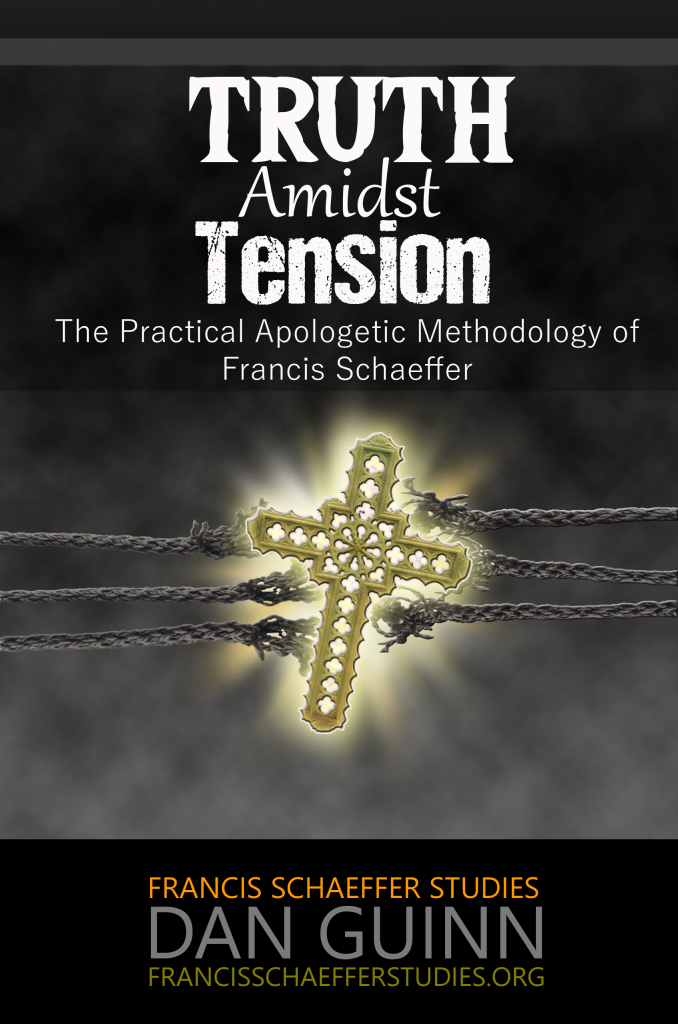
Truth amidst Tension: The Practical Apologetic Method of Francis Schaeffer. Kansas City, Mo.: Francis Schaeffer Studies, 2022. 153 pp., $15.00, pbk.
After most books on the great Evangelical apologist, theologian, and cultural critic Francis Schaeffer, I tell myself, “That time would have been better spent re-reading one of Schaeffer’s books.” There are exceptions. Colin Duriez’s biography, Francis Schaeffer: An Authentic Life (Wheaton: Crossway, 2008) is the first secondary source I recommend to anyone wanting to get a handle on who Schaeffer was, where he was coming from, and what was the significance of his ministry. And now the second, on Schaeffer’s teaching and his apologetic, particularly from the standpoint of methodology, is Dan Guinn’s new book Truth amidst Tension.
Dan Guinn is the founder and director of the online study group Francisschaefferstudies.org and is a member of the executive board of the International Society of Christian Apologetics. As such he has long been a significant behind-the-scenes contributor to the enterprise of Christian apologetics. This is his first book, and into it have gone his years of study of Schaeffer and interaction with the worldwide L’Abri community. He writes not to enter into the sometimes abstruse academic debate over how to classify Schaeffer’s approach but rather to help students of apologetics be able profitably to use Schaeffer as a role model. The word “practical” in his subtitle is well considered and fully meant. Its promise is one that in my judgment the book keeps admirably.
The introduction, where because he must justify his eschewing of the abstract academic approach Guinn has to deal with it, is a bit of a slog. Do not let it deter you, but push through it, because beginning with the first chapter you will start getting what is surely one of the best introductions to Schaeffer on the market. People who have complained that Schaeffer is hard to read will find his basic thought forms and sometimes difficult and idiosyncratic vocabulary explained with faithfulness and clarity. And Schaeffer’s fans will enjoy being reminded of the structure and wholeness of his thought as the different strands of it scattered throughout Schaeffer’s many books are brought together and synthesized in brief compass. I myself felt like I had taken a trip back in time to the late sixties and early seventies when I was discovering Schaeffer’s brilliant analyses, scintillating ideas, and Christian wisdom for the first time. Bringing it all together under one cover is no small accomplishment.
Guinn’s primary purpose is to help us understand Schaeffer’s apologetic method so we can put it into practice ourselves. The non-Christian’s worldview creates a tension with the world he has to live in. Schaeffer can teach us how to find that point of tension (which may be different with various individuals) and use it as a way to make meaningful the superior answers Christianity offers (really, the only answers) to explain “the existence of the universe and its form,” including “the mannishness of man.” Guinn’s concern for truth and for evangelism mirror Schaeffer’s own, and for that reason his book is a resource for pursuing those realities that can worthily take its place alongside Schaeffer’s original contributions. For both, we may be grateful indeed.
The book’s homepage can be found at http://truthamidsttension.com/.
Donald T. Williams, PhD, is Professor Emeritus of Toccoa Falls College. A past president of the International Society of Christian Apologetics, he is the author of thirteen books, including The Young Christian’s Survival Guide: Common Questions Young Christians are Asked about God, the Bible, and the Christian Faith Answered (Christian Publishing House, 2019) and Ninety-Five Theses for a New Reformation: A Road Map for Post-Evangelical Christianity (Semper Reformanda Publications, 2022).
Related