THE WIDOW’S
SON OF NAIN
Luke 7:11-17
A sermon preached at University Church, Athens, Ga., Feb. 23, 2003, at the Mere Christian Worship Service, Mythcon, Berkeley, Ca. Aug. 5, 2012, and at University Church, Athens, GA., June 2, 2019.
7:11 And it came about soon
afterwards, that He went to a city called Nain. And his disciples were going
with him, accompanied by a large multitude. 12 Now as He approached the gate of the city,
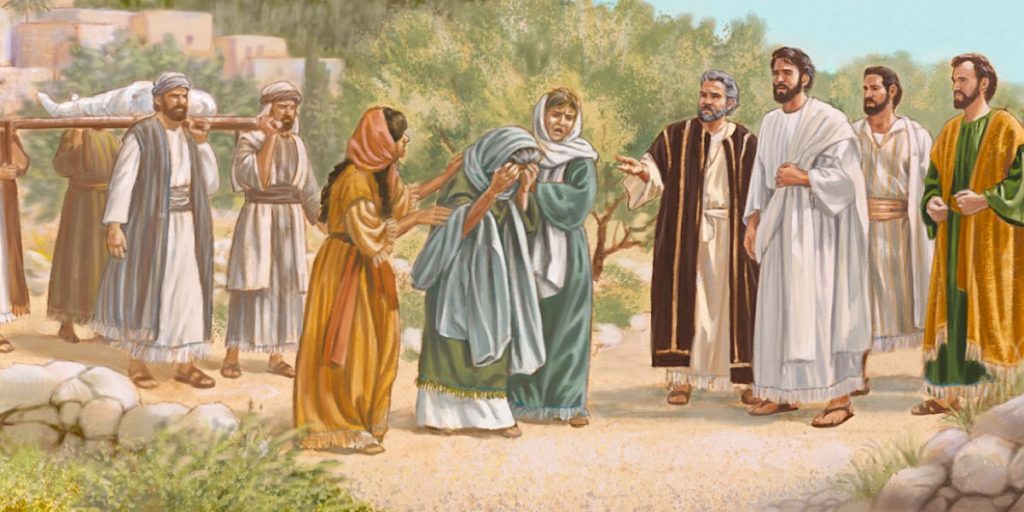
behold, a dead man was being carried out, the only son of his mother, and she
was a widow; and a sizeable crowd from the city was with her. 13 And when the Lord saw her, He felt compassion
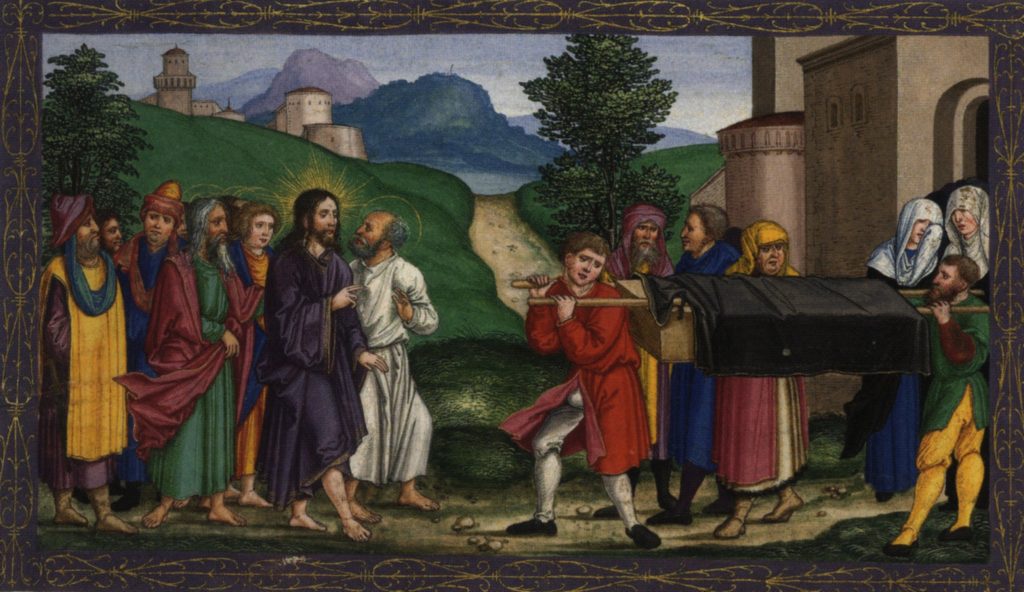
for her, and said to her, “Do not weep.” 14 And He came up and touched the coffin; and
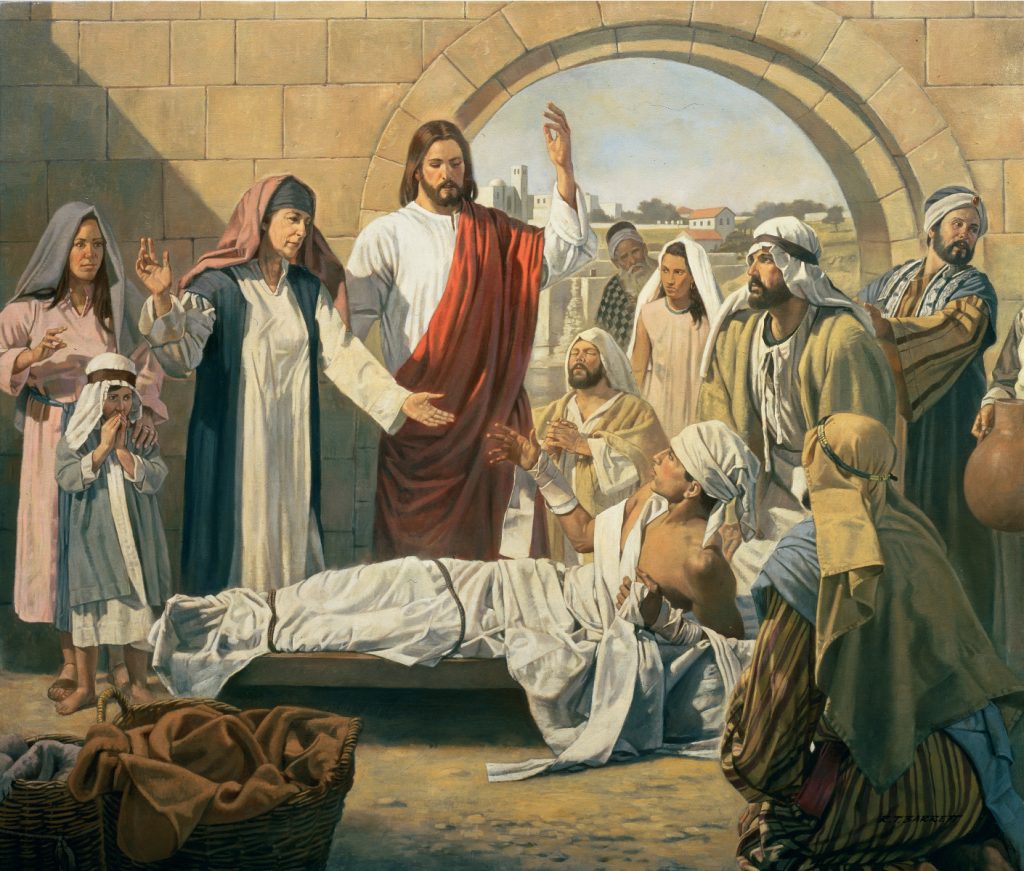
the bearers came to a halt. And He said, “Young man, I say to you,
arise!” 15 And
the dead man sat up and began to speak. And Jesus gave him back to his mother. 16 And fear gripped them all, and they began
glorifying God, saying, “A great prophet has arisen among us!” and
“God has visited His people!” 17 And this report concerning Him went out all
over Judea and in all the surrounding district. (NASB)
INTRODUCTION:
John the beloved disciple tells us that the whole world could not have contained the books if all the deeds of Jesus had been written down. Therefore, those incidents that are included have been selected for a reason. Every miracle story—like this one, for example—is not just another impressive narrative but was chosen by the Gospel writer to tell us something we need to know about Jesus. This one obviously tells us that He could raise the dead. But it tells us a lot more than that. I see at least four important concepts here that are relevant to all disciples who follow Jesus Christ today.
I. THE COMPASSION OF CHRIST (v. 13)
And when the Lord saw her, He felt
compassion for her, and said to her, “Do not weep.”
You know, like
the Lord, I passed a funeral on the road myself the other day: a hearse
followed by a long line of cars all burning their headlights in broad daylight.
I followed our quaint Southern custom of pulling off the road and stopping
until they were past to honor the deceased and show respect to his loved ones. I
did not begrudge showing that much respect; but because I did not know the
people involved, I hardly gave it a second thought, and continued on my way as
soon as they were past. Jesus, on the other hand, took a different
approach: He flipped on his own lights, as
it were, turned his car around, and joined the procession to the gravesite.
Since
his funeral party was not ensconced in two-ton steel projectiles, Jesus was
able to make his way immediately to the side of the grieving mother, a widow
who had lost not only her husband but now her only son–which may well have
meant her only prop for existence. And Jesus felt compassion for her and said
something very interesting: “Do not weep.”
We’ve
all said something like that in awkward situations: “Don’t cry.” But
what in the world do we mean by it? Sometimes we really mean, “Don’t
cry–you’re making me uncomfortable.” Sometimes we ironically mean,
“I wish you didn’t need to cry–but go ahead; there’s nothing else we can
do.” And if we are really kind and empathetic we may join the weeper in
her tears. Christ set us an example in
this when he wept at the tomb of Lazarus.
He was going to do something much more radical than that, but first he
joined the suffering people in their tears. But there is also a third scenario
that some of us have enacted, perhaps when rushing to the side of one of our
children when they were little. Then, “Don’t cry” may mean, “Your cry for
help has been answered. So you can stop crying now: I am here!” This poor
widow could not have known she was in a position to hope for anything more than
the second meaning: “I sympathize.” But
this third one was what Jesus was really saying, as she would soon discover to
her everlasting astonishment and joy.
What
is the point? There is sorrow, tragedy, and pain in every life in this room
sufficient to make us all cry if we were to think about it too long and hard.
“Man is but dust,” said John Donne, who has been “coagulated and
kneaded into earth by tears.”[1]
But the Lord Jesus Christ, representing God the Father, still says to us–He
says it this very moment as we read this passage–“Do not weep!” And what does He mean? He means, “I join you in your tears here
and now. I too was a man of sorrows and
acquainted with grief. I was tempted in
all ways like as you are. I know! In understand!” But He says more than that: “The day is coming when all your tears will
be wiped away.” In its fullness at the Second Coming, we will hear–by
foretaste and down payment even now, we may hear–Jesus saying, “Your cry
for help has been answered. So you can stop crying now: I am here!” Jesus, representing the Father, says it to us. And
we, representing Jesus, should be saying it for Him with meaning to others:
“Do not weep! Don’t cry!” For
Christ is here; and we are here on His behalf.
The first lesson this passage highlights for us is then the compassion of Christ. But the second one is . . .
II. THE POWER OF CHRIST (v. 14-15)
And He came up and touched the coffin; and the bearers came to a halt. And He said, “Young man, I say to you, arise!” And the dead man sat up and began to speak. And Jesus gave him back to his mother.
As a Minister of
the Gospel I have often had to preside at funerals. There one has the great
privilege of offering comfort, sympathy, support, and hope based on the
glorious Gospel of salvation in Jesus Christ. But there is also in such moments
a feeling of impotence. I can offer hope for the future if the deceased was a
believer, but I cannot reverse what has happened in the immediate past. I can
offer comfort for the present, but I cannot fill the gap that has been left in
people’s lives. But the point of this passage is that Jesus could. The amazing point of this passage is that
Jesus did. The astounding point of this passage is that Jesus can. The glorious
point of this passage is that Jesus will.
For the dead man sat up and began
to speak.
The
power manifested by any victory is revealed by the greatness of the Foe who has
been defeated; so also the glory that accrues to the Victor is coordinated with
the majesty of the Foe overcome. I recall in 1980 when the University of Georgia
defeated Notre Dame in the Sugar Bowl to win the national championship, that
Coach Vince Dooley was carried off the field by his team in celebration. The
following year, I was present in Sanford Stadium when the “Dawgs”
defeated the Richmond Spiders–that year’s homecoming patsy—by a rather
astronomical score for those days of Dooley’s conservative,
three-yards-and-a-cloud-of-dust offense. The margin of victory was much
greater, but somehow nobody seemed to think it was much of a big deal. Coach Dooley had to walk off the field on his
own two legs. The power manifested by any victory is revealed by the greatness
of the Foe who has been defeated.
Well,
what is the Enemy being overcome here? Jesus overcomes the futility, the
finality, the irrevocable void, of Death. In Greek mythology, Hades, the god of
the Underworld, the god of the Dead, is the most hated of all the immortals,
because he is the only god who never answers prayer. Never.
The exception
that proves the rule is the story of Orpheus and Eurydice. Orpheus was the greatest of mortal musicians.
When his beloved wife, Eurydice, died, he simply could not accept the finality
of that loss. So he took his harp and journeyed to the Underworld. There he
played so beautifully, sang so poignantly of mortal sorrow, that tears of
molten iron ran down the implacable face of Hades, and for the only time ever
recorded, he relented. Eurydice would be permitted to follow Orpheus back into
the world of the living, the world of the sun. But he must not look behind him
until they had both safely emerged from the darkness of Hades’ realm back into
the sunlight. So imagine what he is feeling as he begins the long walk through
the tunnel. He sees the small point of light at the end, and he begins to hear
faint footsteps, growing ever more solid, as Eurydice begins to resume physical
form. How he wants to look and see her again, to verify that it is her
footsteps that he hears! But he dare
not. And now they have almost emerged. One more step and the quest will be
achieved–life snatched back from the grave! But at that moment she stumbles
against a stone and cries out, and by instinct, without thinking, he turns to
catch her and keep her from falling. But
he has broken the ban, he has violated the requirement, he has transgressed the
taboo. It is one step too soon—one lousy step! And so he turns only to see her
for one intolerably heartbreaking moment reaching for him as she evaporates and
fades back into the mist, forever lost in the darkness.
Hades is the
only god who never answers prayer. And that is the hardest thing about Death to
accept: that impenetrable stone wall
suddenly erected across your path, that steel door slammed in your face. No matter how important and essential the
deceased was to your life, you aren’t getting him back. That is what makes it
the great and final Enemy: “The
last enemy to be defeated is death” (1 Cor. 15:26). And that is what Jesus overcame! No wonder
the people were filled with terror and awe when the dead man sat up and began
to speak.
The second lesson we learn from this passage is the power of Christ. And the third is . . .
III. THE PARADIGM OF CHRIST’S ACTS
The third thing
we must see in this passage as a whole is a paradigm, a basic pattern or grid
for understanding all the acts of Jesus as we read about them in the New
Testament. What does this victory tell
us about Jesus? And how does it do this
telling? This deed, and others like it, do two things: they Announce His
Character, and they Anticipate His Coming.
First,
the miracle stories in the Gospels Announce
Christ’s Character. They tell us who He is.
C. S. Lewis analyzed this aspect of the miracle stories brilliantly in
his great apologetic work, Miracles.[2]
What does it tell you when water is turned into wine—suddenly and immediately,
without the normal apparatus of a grapevine and a wine vat? It tells you that
the Reality which pagans ignorantly
worshipped as Bacchus, the god of wine–the Reality of which Bacchus was only a
faint and corrupted reflection in the minds of men—that Reality has come, is
here! What does it tell you when Jesus multiplies the loaves and fishes? It
tells you that the Reality which pagans ignorantly worshipped as Ceres, the god
of harvest—the Reality of which Ceres was only a faint and corrupted reflection
in the minds of men—that Reality has come, is here! What does it tell you when
Jesus stills the winds and the waves? It tells you that the Reality which
pagans ignorantly worshipped as Poseidon, the god of the sea—the Reality of
which Poseidon was only a faint and corrupted reflection in the minds of men—that
Reality has come, is here! And what does it tell you when Christ raises the
dead? It tells you that One who is stronger than Hades, greater than all the
false gods, stronger even than Fate, has come, and now stands before you. If
you are an ancient Jew you know that it must be Jehovah. If you are an ancient
Greek you realize that your whole concept of what deity is has just been
shattered and now has to be revised. And what if you are a modern secular
American? Oh, my.
The
first thing the miracles stories do is to announce Christ’s character: He is
the Son of the living God. But a second
thing the miracle stories in the Gospels do is to Anticipate Christ’s (second)
Coming. For Scripture itself teaches us to read such passages in terms of
the principle of the Pledge or Down Payment. Paul tells us that when we
accepted Christ we were “sealed in Him with the Holy
Spirit of promise, who is given as a pledge of our inheritance” (Eph.
1:13-14). Another way of seeing the same principle is in terms of a Foretaste.
Hebrews describes us as having “tasted the good word of God and the powers
of the age to come” (Heb. 6:5). So what Christ does in the Gospel miracles
is to give us a glimpse, a sneak preview, as it were, of what He is going to do
on a cosmic scale when He returns. I remember how excited some of us were when
the first previews of Peter Jackson’s Lord
of the Rings movies started showing up in the theaters or on television.
Well, some of us don’t think the movie quite lived up to our expectations. But these previews are not going to
disappoint! When we look
back to the miracle stories of the Gospels, or when we look to the no less
supernatural and astounding miracle of our own regeneration right now, we
should connect these things together as an eloquent whole that both whets our
appetite for the future and builds our faith in the meantime. May God allow
them to work, to make it so, in our lives.
The third thing this passage gives us is a paradigm for understanding Christ’s acts: the paradigm of the Pledge, the Down Payment. And the fourth thing it shows us is . . .
IV. THE PROMISE OF CHRIST (v. 16)
And fear gripped them all, and they began
glorifying God, saying, “A great prophet has arisen among us!” and
“God has visited His people!”
God has visited
His people! And because that visit of
old was not an isolated event but a paradigm, we know He will visit us again to
complete the work that was begun then.
Therefore, the Compassion of Christ, the Power of Christ, and the
Paradigm by which we should read his actions lead us to our last point: the
Promise of Christ, the Hope that He gives us for the future. When I read this
passage and others like it, I know that the Day is coming when Jesus will
finally say to all of us, “Do not weep.” The comfort He gave to this
widow then, the comfort He gives to His disciples even now, all point to that
Day which is coming. So when I read this passage I know that a Day is coming
when all the injustices, the futility, and the petty hassles of life will be no
more. When I read this passage I know that a Day is coming when the whips and
scorns of time, the proud man’s contumely, the oppressor’s wrong, the pangs of
despised love, the law’s delay and the thousand natural shocks that flesh is
heir to will be no more. When I read this passage I know that a Day is coming
when my grandfather and grandmother whom I buried will stand before me in
glorified flesh. When I read this passage I know that a Day is coming when my
experience in the summer of 1994 will be reversed.
For about thirty
minutes that summer, time was frozen for me in the churchyard of the Headington
Quarry parish church as I knelt at the grave of C. S. Lewis. Never has the
weight of our mortality bowed me down more severely than at that moment. For I
had been hanging on every published word of this man for over twenty-five
years. He had saved me from apostasy when I was a doubting and questioning high
school student; he had taught me how to think like a Christian. I literally
owed this man my life, and had come to feel I knew him and loved him as a
friend. And here he was only six feet away. But the barrier of Death was a more
solid wall between us than the stone slab of his tomb or the steel walls of his
casket; had I broken through those barriers the distance would still have been
infinite and unbridgeable. I had been closer to him with my nose in one of his
books on the other side of the Atlantic. I was looking for a closer connection,
but I was absolutely stymied. That is
what Death has done to us! And so the truth of the words carved on the stone
was carved also into my soul: “Men must endure their going hence.”
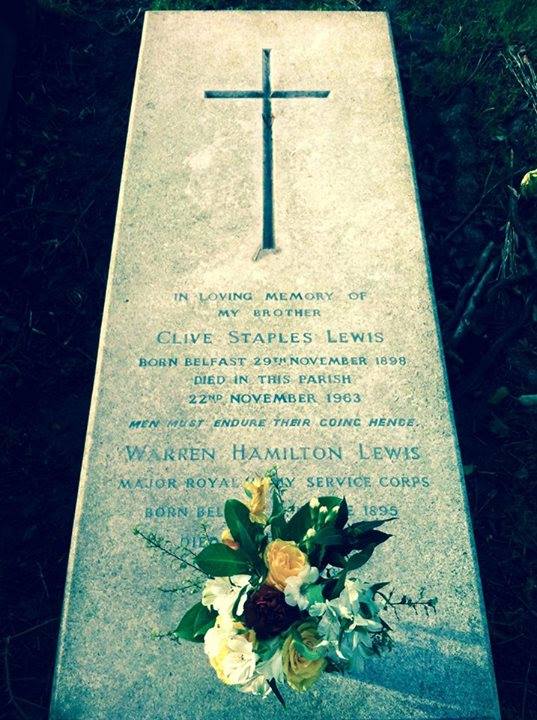
THE GRAVE OF C. S. LEWIS
There was a marble slab, the evidence
Of burial, with writing on the stone
Which said, “Men must endure their going hence.”
The mind that had restored my mind to sense
Was here reduced to elemental bone;
There was a marble slab, the evidence.
That well of wisdom and of eloquence
Was now cut back to just one phrase alone
Which said, “Men must endure their going hence.”
No monument of rich magnificence
Stood fitting one who had so brightly shone;
There was a marble slab. The evidence
That plain things have their power to convince
Was in that simple block with letters strewn
Which said, “Men must endure their going hence.”
The weight of Time was focused there, intense
With wrecked Creation’s universal groan:
There was a marble slab, the evidence,
Which said, “Men must endure their going hence.”[3]
But that was not
the last word to be uttered. For in the silence of that moment I could also
hear the voice of Izaak Walton applying to Lewis the words he had originally
written for John Donne:
“He
was earnest and unwearied in the search of knowledge; with which his vigorous
soul is now satisfied and employed in a continual praise of that God that first
breathed it into his active body, that body that was once a temple of the Holy
Ghost and is now become a small quantity of Christian dust.”
“But
I shall see it reanimated!”[4]
The fourth
lesson we learn from this passage is the promise of Christ.
CONCLUSION:
Christians
are people of joy because even in the midst of their greatest sorrows they are
people of hope. Why? Because of the way
the compassion of Christ, the power of Christ, the paradigm by which we
understand Christ, and hence the promise of Christ are revealed by stories such
as this one. Because already it lets us
hear Jesus say, provisionally “Do not weep! Help has arrived! I am
here!” Because on that Day Jesus
will say, finally and forever, “Do not weep! Help has arrived! I am
here!” I know that Day will come because when I read Luke’s Gospel I know
that this day came. That is the hope the Bible gives us. Let us share it with the world, by saying,
with our mouths and with our deeds as Jesus’ representatives, “Do not
weep.” And let us praise the Father for
it.
Here endeth the Lesson.
Donald T. Williams (B.A., Taylor University, M.Div., Trinity Evangelical Divinity School, PhD, University of Georgia) is R. A. Forrest Scholar and Professor of English at Toccoa Falls College in the hills of NE Georgia. He is the author of eleven books, including Mere Humanity: G. K. Chesterton, C. S. Lewis, and J. R. R. Tolkien on the Human Condition (Nashville: Broadman, 2006, rpt. Chillicothe, OH: DeWard, 2018), Deeper magic: The Theology Behind the Writings of C. s. Lewis (Baltimore: Square Halo Books, 2016), and An Encouraging Thought: The Christian Worldview in the Writings of J. R. R. Tolkien (Cambridge, OH: Christian Publishing House, 2018). (His website is www.donaldtwilliams,com. He blogs at www.lanternhollow.wordpress.com and www.thefiveilgrims.com.
[1] John
Donne, Devotions Upon Emergent Occasions,
“Meditation VIII” (1624), in Alexander M. Witherspoon and Frank J.
Warnke, eds., Seventeenth Century Prose
and Poetry, 2nd. ed.
(N.Y.: Harcourt Brace Jovanovich,
1982), p. 64.
[2] C. S.
Lewis, Miracles: A Preliminary Study (N.Y.:
MacMillan, 1947), pp. 116-21, 140ff.
[3] Donald
T. Williams, “The Grave of C. S. Lewis:
Headington
Parish Church,
Oxfordshire. Villanelle no. 15,” Christianity and Literature 44:2 (Winter
1995): 180; rpt. in Stars Through the
Clouds: The Collected Poetry of Donald T. Williams (Lynchburg: Lantern Hollow
Press, 2011): 314.
[4] Izaak
Walton, The Life of Dr. John Donne
(1675), in Alexander M. Witherspoon and Frank J. Warnke, eds., Seventeenth Century Prose and Poetry, 2nd.
ed. (N.Y.: Harcourt Brace Jovanovich, 1982), p. 271.
Related