A good book review can perform three services. First, it alerts us to what might be worth our time amongst books coming out now, with description, critique, and evaluation. Second, it lets us comment on issues the book deals with whose significance is ongoing apart from the book itself. Finally, it can have a second life as a signpost to classic works from the past that we might have missed or of which we need to be reminded.
Therefore, I’m going to resurrect some of my old reviews that I think fulfill all these functions. I hope you will be reintroduced to some old friends or helped to find a new one.
Leland Ryken, The Word of God in English: Criteria of Excellence in Bible Translation. Wheaton: Crossway, 2002, 336 pp., pb., $16.00.
 Leland Ryken
This is a book that every reader, teacher, or preacher of the English Bible needs to read. Leland Ryken, former chair of the English department at Wheaton and a prolific writer on both literary and biblical topics, challenges the direction in which Eugene Nida’s “dynamic equivalence” theory of translation has taken modern translations, charging that they have robbed God’s revealed Word of much of its power and authority.
Ryken argues that one cannot take a book written for intelligent adults and limit it to a sixth-grade reading level without misrepresenting its content and its very nature. He demonstrates the strong tendency of many modern translations to substitute abstractions for the concrete imagery of the original text, to substitute explanations for the figurative language of the original text, and to eliminate the technical theological vocabulary which the original authors of the text chose to use. Thus they offer their helpless English readers a text that has been predigested, a text that has already been preemptively interpreted for them without their awareness or consent.
Dynamic equivalence begins from the truth that idioms differ from one language to the next, so that a “literal” translation does not always make sense. Therefore one tries to find the structure in the receptor language that would have an equivalent effect to the one used in the original text.
Such an approach is, at least at points, unavoidable. But Ryken shows that, when combined with the anti-intellectualism and evangelistic pragmatism of contemporary Evangelicalism, this theory has been the excuse for a confusing and bland array of renderings that give us a very different Bible from the one God actually inspired, which was a concrete text full of poetry and mystery and not bashful about making demands upon its readers. He raises the question how Evangelicals can continue to hold to plenary verbal inspiration as opposed to “thought” inspiration, and yet tolerate an array of translations that do not feel obligated to convey anything more than what their scholars take to be the “thoughts” of the biblical writers, ignoring the forms by which the writers chose to convey those thoughts. This, he convincingly argues, robs the text of some of its power and beauty and robs its readers of the opportunity to interpret it for themselves.
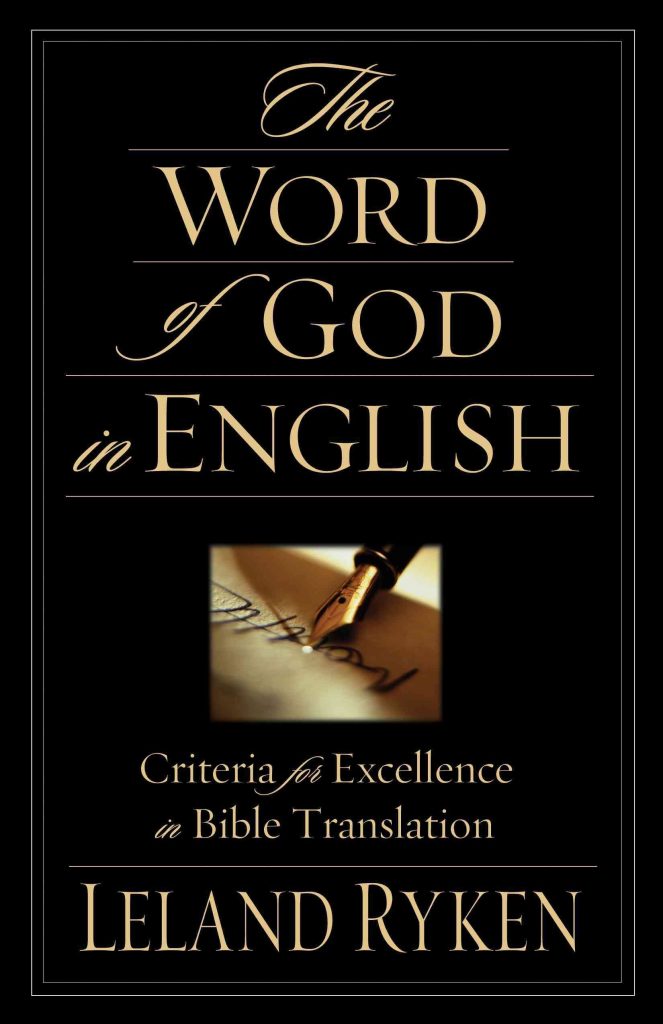
Of Ryken’s many excellent books, this one may be the best, presenting passionate and lucid argument on a topic whose importance cannot be overemphasized. He supports his contentions with an array of quotations comparing “essentially literal” translations such as KJV, RSV, NASB, and ESV with their dynamic equivalent counterparts such as LB, NLT, CEV, NIV, and TNIV. The unity and faithfulness of the one tradition versus the variety and sometimes even capriciousness of the other becomes starkly apparent in cumulative effect, lending credence to Ryken’s claim that dynamic equivalence as actually practiced by many contemporary versions has “destabilized the text” as well as confused translation with interpretation. If Ryken is right, the translation we use for preaching and teaching is not a matter of indifference, for it will have a great influence on how and what we teach. All who care about the Word and who want to read it accurately will want to wrestle with this book.
Donald T. Williams, PhD, is Professor Emeritus at Toccoa Falls College. He is the author of thirteen books, including Deeper Magic: The Theology behind the Writings of C. S. Lewis (Square Halo Books, 2016), An Encouraging Thought: The Christian Worldview in the Writings of J. R. R. Tolkien (Christian Publishing House, 2018), The Young Christian’s Survival Guide: Common Questions Young Christians are Asked about God, the Bible, and the Christian Faith Answered (Christian Publishing House, 2019), and Ninety-Five Theses for a New Reformation: A Road Map for Post-Evangelical Christianity (Semper Reformanda Publications, 2021).
Related