THE GREAT PHYSICIAN, Luke 4:38-44
A sermon preached at Trinity Fellowship, Toccoa, Ga., 6/5/94, and at University Church, Athens, Ga., 10/28/18
4:38 And he arose and left the synagogue and entered Simon’s home. Now Simon’s mother in law was suffering from a high fever, and they made request of him on her behalf. 39 And standing over her, he rebuked the fever, and it left her. And she immediately arose and waited on them. 40 And while the sun was setting, all who had any sick with various diseases brought them to him; and, laying his hands on every one of them, he was healing them. 41 And demons also were coming out of many, crying out and saying, “You are the Son of God!” And rebuking them he would not allow them to speak because they knew him to be the Christ. 42 And when day came, he departed and went to a lonely place. And the multitudes were searching for him, and came to him, and tried to keep him from going away from them. 43 But he said to them, “I must preach the kingdom of God to the other cities also, for I was sent for this purpose.” 44 And he kept on preaching in the synagogues of Judea.
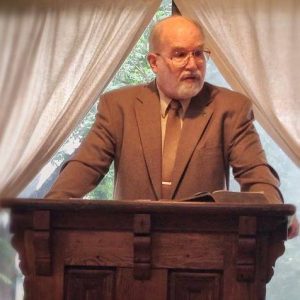
Dr. Williams Preaching at University Church
INTRODUCTION: Throughout all four of the Gospels people frequently ask about Jesus, “What manner of man is this?” We have certainly been asking that question in our study of Luke’s Gospel, even when we have not articulated it as such. What manner of man is this that you cannot study his life or come to know him without asking, “What manner of man is this?” What manner of man is this who submits to a baptism of repentance without confessing any sins? What manner of man is this on whom the Holy Spirit descends like a dove? What manner of man is this to whom a Voice from heaven says, “You are my beloved Son in whom I am well pleased”? What manner of man is this who puts so much energy and concentration into resisting temptation that he forgets to eat for forty days? What manner of man is this who refuses to compromise even when it alienates his own hometown? What manner of man is this who teaches with authority, not as the scribes? What manner of man is this who casts out demons with a simple word of command? And today we ask it again: What manner of man is this who heals with a touch? As we try to answer that question we must consider the ministry of healing, the motive for healing, the methods of healing, the message of healing, and the meaning of healing in Jesus’ life.
I. THE MINISTRY OF HEALING
The ministry of healing certainly had an important place in Jesus’ mission. Part of the prophecy from Isaiah he had used to announce his purpose at the synagogue of Nazareth in Luke 4:18 was giving sight to the blind. That literal physical healing of actual physical blindness, and not just a spiritualized “enlightenment,” was an important aspect of the fulfillment of that promise, is showed by multiple examples from Jesus’ life, though of course it also has reference to giving spiritual insight to people blinded by sin. Nevertheless, starting with Peter’s mother in law, physical healing was the aspect of Jesus’ ministry that attracted the most attention and gave Him the opportunity to deliver His spiritual message to a larger audience. The point of it is that in the coming of this Messiah all the effects of the Fall are to be reversed, including physical illness.
But though physical healing had an important place in Jesus’ ministry, it did not have the central place. When Jesus tears himself away from the crowd in vs. 43, he does not offer as justification that he had to heal in other cities too. He was sent to preach the Gospel, the good news, of the kingdom, that is the rule, of God, in every city. Preaching the Gospel of the kingdom was primary; healing was secondary. It was important, as a means to the end of preaching the Kingdom and as a living illustration of it; but it was still secondary. And even more basic and important than either was making atonement for our sins–for that was to bring the kingdom he had been preaching.
Healing was present in Jesus’ earthly ministry then as a sign that the true Healer was here and as a foretaste of the complete reversal of the effects of sin that the atonement would make possible, but which will be fully manifest only when Christ returns. That is one reason why Jesus had reminded the Nazarenes that of all the lepers in Israel in the days of Elisha, only Naaman the Syrian was healed. Healing is one of the effects of the atonement, but it is not the central thing. There are two mistakes, therefore, that we can make concerning miraculous physical healing today. One is to believe that Christ no longer heals in response to the prayers of his people. The other is to make healing so central to the atonement that it can be “claimed” automatically by faith in the same way as the forgiveness of sin. Each of these errors, in its own way, is simply cruel. One takes away hope, and the other gives a false and unrealistic hope that often only adds guilt to the suffering people are already experiencing.
II. THE MOTIVE FOR HEALING
What then was Jesus’ motive for healing? There are a number of reasons for the emphasis that healing had in the Lord’s earthly ministry. One was to vindicate his claim to be the sight-restoring Servant Isaiah had prophesied. One was to show the connection between the atonement and the curse, one of the effects of which (disease) is being undone. These are important purposes served by the healing stories in the Gospels.

Artist’s Rendering of Jesus Preaching in the Synagogue
But when the Gospels speak of Jesus’ personal motives for healing, of the emotional wellsprings of his willingness to labor so tirelessly at it, two feelings stand out. One is simple compassion for the suffering of the victims. “And Jesus was going about all the cities and villages, teaching in their synagogues and proclaiming the gospel of the kingdom, and healing every kind of disease and every kind of sickness. And seeing the multitudes, he felt compassion for them” (Mat. 9:35-36). In Luke we see this compassion in a couple of ways. First we see it in the individual attention he gave to the people he healed, laying hands on each one individually. And while the sun was setting, all who had any sick with various diseases brought them to him; and, laying his hands on every one of them, he was healing them (Luke 4:40). Then we see it is His staying up all night to meet their needs. And when day came, he departed and went to a lonely place (vs. 42).
So Jesus’ compassion stands out, not only by being mentioned but also by being demonstrated practically in His actions. But there is another motive that also came into play. Of everything that Jesus did, we know that his meat and drink was to do the will of his Father and glorify him (John 4:34). In Luke, the thing that moves Jesus to begin his ministry is that “the Spirit of the Lord was upon Him” (4:18). The Holy Spirit during Jesus’ earthly life functioned as the Liaison between Him and the Father when the Father was not speaking from Heaven, saying “This is my beloved Son.” The Spirit provided both direction and power that came from the Father. So this is Luke’s way of saying what Jesus said in John’s Gospel: His meat and drink was to do the will of the Father. His motive then was twofold: compassion for the people and zeal for the Father’s will and for His glory.
For us too, then, compassion for people and zeal for God’s glory must be the twin motives that drive whatever ministry the Father gives us. It cannot be just one or the other; it has to be both together. If either is lacking, true healing of body or soul will not occur, for neither can be true, whole, or sustainable without the other. Zeal for God’s glory that does not involve real compassion for hurting people will not promote God’s glory at all, but is very liable to be mistaken for self-righteousness—because it is very likely to be self-righteous. If you really care about God’s glory you must care about what He cares about. And compassion that is not rooted in and sustained by devotion to the glory of God will also fall short. It may be misguided in its application, and even if it is not it will fail to address the deeper needs that underlie our merely physical suffering. Like Jesus, we have to keep the two together.
III. THE METHODS OF HEALING
Jesus used at least three methods in his healing ministry, and each of them has something to teach us. Often he healed simply with a word, as with Peter’s mother in law in vs. 39. Here as with the exorcism we saw last time, there is an instructive contrast with contemporary Jewish exorcists and miracle workers, the “faith healers” of their day. Here is a formula that was actually used by one of those guys. To cure a fever, you must tie an iron knife by a braid of the victim’s hair to a thornbush. Repeat over the bush on successive days Exodus 3:2, 3:3, 3:4, and finally 3:5. Then cut down the bush while reciting a secret formula. (What is the formula, you ask? It is not revealed. It is secret.) Do this, the rite promises, and the fever will die with the thornbush. Hmmm. Chances are that by the time that rigmarole was finished the fever would have subsided naturally anyway. The power and authority of Christ stand out by contrast in such bright relief that no commentary is really needed. Remember the casting out of the demon in the Synagogue of Capernaum last August? Boom! You’re outta here! The same kind of unprecedented authority and power is used with disease.
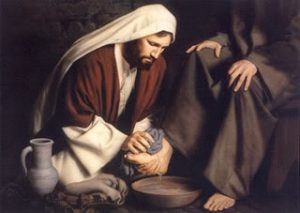
Jesus went out of His way to touch others.
Another method Jesus employed was healing at a distance, as with the centurion’s servant who will be healed when we get to chapter seven. This is another sign of the astounding power and authority Jesus had. He does not even have to be present to pull off a healing. When the centurion’s messengers get back to the house, they find the boy in good health. In some accounts it is noted that the healing occurred at precisely the time when Jesus, who had not been there, had pronounced it.
But by far the most common method, indeed Jesus’ preferred method, is healing by a touch (vs. 40). He goes out of his way to do this. He does it even with lepers, the last people you would want to touch; He does it even when it is less efficient, as in this passage. That is why He ends up spending all night at it. Why? Because there was something at stake here more important than healing people’s bodies. Touching them was a way of personalizing the act, of establishing a relationship with the one being healed–or at least giving him the opportunity to enter into one. Why not just snap his fingers and heal everyone in Judea in one fell swoop? He could have, surely, if He can heal with a word and at a distance. Why leave this town with people who are yet unhealed? (That’s why they were looking for him the next morning.) Because there was something more important than physical cures at stake. And that leads us to the next point.
IV. THE MESSAGE OF HEALING
What was the message of Jesus’ healing ministry? We have already hinted at it, but let us bring it into focus at this point. That message had at least three parts. Every healing Jesus performed was an Expression of Mercy, it was Evidence of Messiahship, and it was an Offer of Meeting. It was an Expression of Mercy. Each healing was an acted parable, saying, “God cares.” It was Evidence of Messiahship. Every healing was an acted sermon, declaring, as Jesus had declared at Nazareth, “This day is fulfilled in your ears, not just Isaiah but all the prophecies and promises of the Old Testament.” And it was an Offer of Meeting. That was the reason for the laying on of hands. It is all because then as now the primary issue was not physical health and comfort but a relationship with Christ.
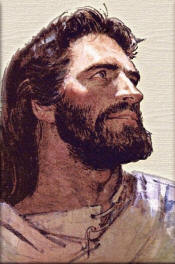
Healing was Evidence of Messiahship
Don’t misunderstand me. If you or someone you love is hurting from or hindered by a physical illness or disability, that is a very significant thing to you. I’ve been there a number of times, so believe me, I know! I do not mean to minimize physical suffering, but the point still needs to be made: There is something even more important here than that. And what could that be? Every healing in Jesus’ ministry was an opportunity for someone to accept Jesus as God’s Messiah. Look for this issue to come increasingly to the fore in future healing narratives. And let us make sure it stays at the forefront in our own lives, when we seek healing for ourselves or for others we care about. Ask for physical healing by all means; work for it if you can. But don’t lose sight of the even more significant healing that Christ offers too. Physical healing is an expression of mercy, and for that we are grateful; it is evidence of Jesus’ messiahship, and from that we receive encouragement and joy; but it is also an offer of meeting, a chance for the beginning or the deepening of our relationship with Christ, and for that we bow in worship and adoration. Amen.
V. THE MEANING OF HEALING
We have looked at the ministry of healing, which had an important but not the primary place in Jesus’ earthly labors; the motive for healing, which was compassion for people and zeal for the Father and His glory; the methods of healing, which focused on physical touch in order to make the healing personal; and the message of healing, which was an expression of mercy, evidence of Messiahship, and an offer of meeting. Alright, then, what is the meaning of Jesus’ healing miracles for us today? We can answer that question with a series of questions.
- Does God still heal miraculously today? He is still the same God, and the Christ He sent is still present in our lives through his personal Representative and Agent the Holy Spirit. All healing comes from God, always, whether it happens naturally through the body’s own repair mechanisms, whether it happens naturally through the aid of medicine, or whether it happens miraculously. But there is no automatic guarantee of healing in this life just because we have enough faith. Paul had to bear his thorn in the flesh with the realization that God’s grace was sufficient. And sometimes God heals us by releasing us from a diseased and failing body to come and be with Him in spirit until He gives us the ultimate healing of the Resurrection of the Dead when Christ returns. Unless Christ returns first, this will eventually be the answer to all our prayers for healing. Even Lazarus was resurrected only to face the prospect of getting sick and dying all over again. There may be many healings, even miraculous ones, along the way to encourage us and to give us foretastes of what is coming, but we will not be finally healed until we see Christ face to face.
- If Jesus is so compassionate, why doesn’t God always heal us when we ask Him in faith? We could restate that question in another way: Why didn’t He heal everyone in Judea in the First Century? It’s really the same question, isn’t it? Surely part of the answer is that if He had done so He would have left the First-Century Judeans satisfied—and still in their sins. Even those He did heal did not all follow Him. Of the Ten Lepers, only one returned to give thanks. God knows that we are not mature enough to handle automatic guaranteed healing. We would stay babes in faith if we had faith at all; people would be “believing” for all the wrong reasons. God sends us healing to encourage us, but if it always came we would cease to share in the groaning of creation. We would then minister with less compassion for a lost and needy world with which we could no longer identify, and we would cease longing for our full redemption when Christ returns as it deserves to be longed for. And none of those things would be good. Each would be worse than any sickness we are called to endure.
- Finally, what does healing mean when it does come? It is an acted parable saying that Jesus cares. It is an acted sermon saying that Jesus is the Messiah and that the words of Isaiah are fulfilled in your ears. It is a demonstration that God cares about the whole man, not just the spirit but the body too, not just Sunday but the rest of the week too, not just “religion” but all of life. It is a down payment on a future when there will be no more tears. It is an opportunity to grow closer to the Lord. And, finally, it is an opportunity to worship Him, to ask in awe, “What manner of man is this?” And to ask it with a wee bit of a greater inkling of the answer.

The house where University Church meets
CONCLUSION: God’s interest in the whole man, body as well as spirit, is shown by the healing ministry of Jesus. It is also shown by the physical elements of bread and wine by which we celebrate the Lord’s Supper, that feast which points forward to the Marriage Supper of the Lamb, when sickness will be no more. Let us think of the Lord’s Supper in those terms today as we recommit ourselves to him by partaking of it.
Here endeth the Lesson.
Donald T. Williams, PhD, is ordained in the Evangelical Free Church of America, is R. A. Forrest Scholar at Toccoa Falls College, and is a member of University Church, an interdenominational house church in Athens, GA. The author of eleven books and countless articles, he is a border dweller, camped out on the borders between serious scholarship and practical ministry, literature and theology, Narnia and Middle Earth. His latest books are Deeper Magic: The Theology behind the Writings of C. S. Lewis (Baltimore: Square Halo Books, 2016) and “An Encouraging Thought”: The Christian Worldview in the Writings of L. R. R. Tolkien (Cambridge, OH: Christian Publishing House, 2018).

Related