Review of “TOLKIEN” Biopic (2019; some spoilers):
I vouch for none of the details in this film at all. They are only roughly suggestive of the real history, and those knowledgeable about Tolkien’s life who focus on them will be disappointed. For example, the picture has the famous letter to Edith being written beforehand and waiting to be mailed, rather than Tolkien rising from his bed at the stroke of midnight on his 21st birthday to put pen to paper. Why, I can’t imagine, for the real scene is much more dramatic–unless the writers or the director did not think it believable. They make Edith a bit more of Tolkien’s intellectual peer than she apparently was in reality. And I doubt he was actually wandering the trenches of the Somme in near delirium looking for his friend and going over the top trying to find him. But the details are not the point. The general impression is. It’s not a documentary; it’s a drama, and as such in many ways a better portrait of Ronald and Edith’s love story than Shadowlands was of Jack and Joy Lewis’s. So, as for that general impression . . .
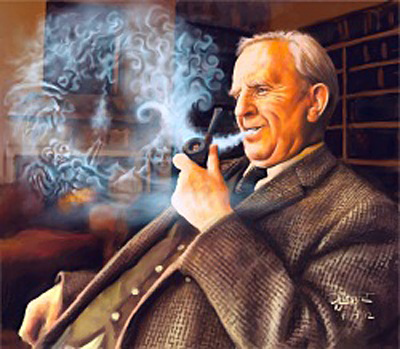 J. R. R. Tolkien
Tolkien is a beautiful movie. And that is saying something, given the number of scenes of the trenches, wastelands, and carnage of Mordo . . . er, The Great War. But many scenes of life back in England are visually beautiful, and the story as a whole captures the beauty of love and of friendship very poignantly. Those are the deepest impressions one walks away with, to the point of weeping at the sheer beauty of them. And those two realities are two of the most important things that Tolkien’s legendarium offers us.
The friendships of Frodo and Sam, of Frodo, Sam, Merry, and Pippin, of Legolas and Gimli, of Aragorn and Eomer, and the loves of Aragorn and Arwen and of Faramir and Eowyn, are pictures of a rich and rooted goodness such as few works of literature can boast. I would hate to have had to live my life without the example and the inspiration they have provided me. Of the many beauties and glories of Middle Earth, its visions of love and of friendship stand out. Where did they come from? No one can answer that question. But this film focuses on such hints as can be gleaned. The Tea Club and Barovian Society—we have known about it before, but seeing it brought to life gives context to Tolkien’s vision of friendship. We knew about his love for Luthien/Edith, but being enabled to imagine it (or something like it) brings the theme of love a wee bit more into focus. Having seen this movie will highlight those themes in fresh ways for my next reading of the Trilogy. This is no small gift for the film to have given us.
I wish there had been more attention given to Tolkien’s Christian faith as related to those things. It would have made the film even stronger. But that is as far as I can go with Michael Ward‘s take on it. The film doesn’t go out of its way to hide Tolkien’s faith, as Ward suggests, but it does not focus on it. And if we had asked Tolkien about the deepest roots of his vision, he would not have omitted it. See for example the moving personal testimony at the end of the essay “On Fairie Stories.” And see my book An Encouraging Thought for a discussion of its significance: Tolkien did not just believe in Christ on Sunday but used those beliefs considered as true as the key that opened up his understanding of literature, of language, and of life.
So this lack of emphasis is a weakness. But we should value the movie for what it did do. It evoked very powerfully the importance of the Tea Club and Barovian Society, of Edith, and of The Great War in the formation of the man who gave us Elvish and Middle Earth, and who made love and friendship so central to his imaginative world. That is a lot of good for one film to do, and I am grateful for it.
Donald T. Williams is Professor Emeritus of Toccoa Falls College. His most recent books include Deeper Magic: The Theology behind the Writings of C. S. Lewis (Baltimore: Square Halo Books, 2016) and An Encouraging Thought: The Christian Worldview in the Writings of J. R. R. Tolkien (Cambridge, OH: Christian Publishing House, 2018). See the latter book for more on the influence of Tolkien’s deep Christian faith on his work.
Related