FIVE THESES ON CHRISTIANITY AND CULTURE:
INTRODUCTION
I am currently
leading a series of discussions in my college/adult Sunday School class on the
relationship of Christianity and culture.
Here are some resources I have developed to help the class in thinking about
this difficult and important topic. Lord
willing, I will revisit each of the theses below in greater detail in these
pages in the coming weeks.

The
Christian church was born out of an ancient Semitic culture into an ancient
pagan culture and has survived into a modern secularist and neo-pagan one in
the West while expanding into every kind of cultural milieu imaginable across
the planet. In the meantime it has been
a major player in creating and molding culture, especially Western culture, and
has had its influence on whatever culture it has entered. But the situation is complicated in that the
influence unavoidably goes both ways. It
is not always easy to discern what in contemporary Christendom represents
universal and non-negotiable truths revealed by God and what reflects the
culture into which those truths have to be incarnated. Another important question: When is that inevitable
cultural flavoring a necessary and even positive reflection of the fact that
the church has successfully indigenized itself incarnationally, and when is it
a corruption of its basic principles?
We have not always done a good job of discerning the answers to such questions. So here are five theses to give us a framework that can help us do better, along with some resources for further study. We will develop each thesis in turn in coming weeks.
- Human beings are creative because they are made in the image of the Creator. (See Tolkien’s doctrine of “sub-creation” in his essay “On Faerie Stories.” We were made in God’s image so that we could not only have fellowship with Him but so we would be qualified to represent Him as His sub-regents and stewards on earth.)
 Tolkien Thinking of Sub-Creation
- 2. Culture is the material, social, and symbolic matrix that results from the full range of mankind’s creative activity. (It includes business, carpentry, farming, and cooking as well as art, music, drama, and literature; all are seamless products of human creativity.)
- 3. Culture is not and cannot be spiritually neutral or irrelevant. (It flows from the very heart of human identity as a creature made in the image of God to serve Him as stewards of His earth—or from our rebellion against that identity.)
- 4. Therefore, Francis Schaeffer was right to insist that part of Christian discipleship is living out “the Lordship of Christ over the total culture.” (Salvation is not just a religious “experience”; it restores us to our role as sub-creators for God’s glory.)
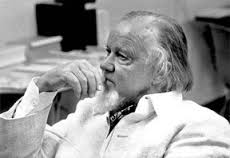 Francis Schaeffer Thinking about Christianity and Culture.
- 5. The Christian subculture in any society should bring salt and light to that society through its own cultural activity, both in creating and consuming culture. (From homemaking to gardening to labor to art and music, the quality of our lives should reflect who we are. This creates the context in which our proclamation of the Gospel can have credibility and power.)
Figuring out how the church should relate to culture and how it should seek to influence culture without being corrupted by it—figuring out how practically, in other words, for it to be in the world but not of it—is not an easy task. It includes, but is not limited to, how the church should relate to media and the arts. I think American Evangelicals need to do a better job of it, and that no Reformation of that movement can be whole and wholesome otherwise. It will be easier if we can come to a theological understanding of what culture is and lay down some basic principles that govern our unavoidable participation in it. That will be the task of these five theses, which we will examine in detail in the coming weeks.
BIBLIOGRAPHY: CHRISTIANITY AND CULTURE
The Foundations of my Understanding of Culture:
J. R. R. Tolkien, “On Fairy Stories,” The Tolkien Reader (N.Y. Ballantine, 1966), pp. 3-84).
Dorothy L.
Sayers, The Mind of the Maker (N.Y.: Harper and Row, 1968).
The Place to Start for Understanding a Biblical
Relationship between Christianity and Culture is Schaeffer’s “Cultural
Apologetic,” laid out in
Francis A.
Schaeffer, The God Who is There (Downers Grove, Il.: InterVarsity,
1968).
Other Important Works wrestling with issues of Christianity and Culture include (in order of publication):
Abraham Kuyper, Lectures
on Calvinism (Grand Rapids: Eerdmans, 1931).
T. S. Eliot, Christianity
and Culture: The Idea of A Christian Society and Notes towards a Definition of
Culture (N.Y.: Harcourt, Brace, and Company, 1940).
H. Richard Niebuhr, Christ and Culture (N.Y.: Harper
and Row, 1951).
Henry R. Van
Til, The Calvinistic Concept of Culture (Philadelphia: Presbyterian and
Reformed, 1959).
Francis
Schaeffer, Art and the Bible (Downers Grove, Il.: InterVarsity, 1973).
 Francis Schaeffer Thinking about Art and the Bible
Leland Ryken, Culture
in Christian Perspective (Portland: Multnomah, 1986).
Andy Crouch, Culture
Making: Recovering our Creative Calling (Downers Grove, Il.: InterVarsity,
2008).
Donald T.
Williams, Inklings of Reality: Essays toward a Christian Philosophy of
Letters (Lynchburg: Lantern Hollow Press, 2012).
Donald T.
Williams, Deeper Magic: The Theology Behind the Writings of C. S. Lewis
(Baltimore: Square Halo Books, 2016), pp. 201-14.
A very helpful Practical Approach to realizing
Christian Culture on a Personal Level:
Edith Schaeffer, Hidden Art (Wheaton, Tyndale, 1971).
Donald T. Williams is Professor Emeritus of Toccoa Falls College. Inklings scholar, Christian apologist, and poet, he is the author of twelve books, including the ones listed above and An Encouraging Thought: The Christian Worldview in the Writings of J. R. R. Tolkien (Cambridge, OH: Christian Publishing House, 2018).
Related