NOT RIGHTEOUS BUT SINNERS
Luke 5:27-32
A sermon preached at Trinity Fellowship, Toccoa, Ga, 6/19/94, and at University Church, Athens, GA, 12/30/18.
Luke 5:27 And after that, he went out and noticed a tax-gatherer named Levi sitting in the tax office, and he said to him, “Follow Me.” 28 And he left everything behind and rose and began to follow him. 29 And Levi gave a big reception for him in his house. And there was a great crowd of tax-gatherers and other people who were reclining at the table with them. 30 And the Pharisees and their scribes began grumbling at his disciples, saying, “Why do you eat with the tax-gatherers and sinners?” 31 And Jesus answered and said unto them, “It is not those who are well who need a physician, but those who are sick. 32 I have not come to call the righteous but sinners to repentance.”

Dr. Williams Preaching at University Church
INTRODUCTION: We have been looking at three incidents in the life of our Lord that illustrate what it means to be a fisher of men. They immediately follow the acceptance by Peter and his friends of the call to be fishers of men, and they amount to Jesus teaching this role to his new disciples by example. Last time we saw how the cleansing of the leper makes the point that man-fishers need to be separated from the world but not isolated from it. As the Lord touched the leper, so we must not be afraid to get our hands dirty in ministry if we are to be fishers of men. Then follow two incidents that make the point that the primary issue involved in man-fishing, the primary thing Jesus came to give us and therefore the primary thing the Gospel offers, is the forgiveness of sins. The first was the healing of the paralytic, where, as we saw last time, Jesus goes out of his way to raise the issue of forgiveness. The second is the calling of Levi (or Matthew, a name by which he is also known and under which he wrote the first Gospel), which we will examine today. To understand this exchange, we must think about the Attitude of the Rabbis, which is the background to the story; the Attack of the Pharisees, which sets up Jesus’ response; and the Answer of the Christ, which is the point we need to take away.
I. THE ATTITUDE OF THE RABBIS
There were basically two theological parties in mainstream Judaism at this time: the Sadducees and the Pharisees. The Sadducees were what today we would call theological liberals. They were secular-minded people who downplayed the supernatural elements of Jahwism and went so far as to deny the doctrine of the resurrection of the dead outright. (That’s why the Sadducees were “sad, you see.”) You don’t hear much from them in the New Testament, though Caiaphas and Annanias were Sadducees, and their scholars did challenge Jesus once on the resurrection with their story about the seven brothers who all married the same woman, and whose would she be in the resurrection? Jesus’ answer was that in the Kingdom we will neither marry nor be given in marriage but be like the angels—that basically that they were missing the point of both marriage and of the resurrection. (We’ll deal with that when and if we ever get there.) You don’t hear much about the Sadducees because they were usually too secular-minded to be all that interested in one more nut claiming to be the Messiah; hence most of Jesus’ debates were with the Pharisees, as in this passage.

The Pharisaic party were what today we might call the conservatives, or maybe even the puritans. They saw themselves as the guardians of the true Jewish traditions. They generally have a bad name amongst Christian believers today because they spend so much time in the Gospels being refuted and even made fools of—and deservedly so, given their judgmental and legalistic attitudes. But we must also remember that they were at least enough on the same page with Jesus to be arguing with him; they at least perceived that they and Jesus had something to discuss. They were at least participating in the same conversation. The Pharisees were dead wrong at many points, but at least they and Jesus inhabited the same universe of discourse. Most of the early Jewish converts—like the Apostle Paul, for example—were from the Pharisaic party. If they were wrong, at least they were wrong about the right things, you might say—as we will see here in their attitudes toward three very specific things relevant to this encounter.
A. Their Attitude to Repentance. The very crux of the difference between Jesus’ understanding of theology and that of the Pharisees lies here. For the Pharisees, repentance is itself a meritorious act whereby a sinner turns himself back to the Law. They at least understood that people are sinners who need to be forgiven. But in their mind we must merit forgiveness through good deeds, fasting, alms, and the study of the Law. What must a sinner do to be pardoned? Or, to put the question as one of them did to Jesus on another occasion, “What must I do to be saved?” Here is a typical Pharisaic answer to that question: “If [a man] had been accustomed daily to read one column in the Bible, let him read two; if he had been accustomed daily to learn one chapter of the Mishnah, let him learn two” (Edersheim, Life & Times of Jesus the Messiah, p. 513). Well, why not three? Why not four? Where does it end? This has an interesting corollary: for all practical purposes, only Pharisees—professional students and teachers of the Law as they were—could be saved! There was little hope for the despised “people of the earth,” the “am ha-aretz.” God was ready to receive them if they would repent, but they had to make not only the first move, but travel all the way back themselves through their own efforts. Theoretically they could make it, but the Pharisees weren’t holding their breath. You can imagine they were not thrilled with Jesus’ idea that all the prodigal son had to do was confess his sin to receive far more acceptance than he was capable of imagining. They weren’t thrilled with Jesus’ declaration that the Publican—a tax collector!—was justified just for beating his breast and crying, “God, be merciful to me, a sinner.” They wanted nothing to do with Jesus’ idea that salvation was by grace, by free grace, and grace alone.
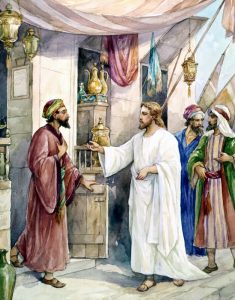
B. Their Attitude to Tax-Collectors. The Pharisees looked down their long Jewish noses at sinners in general, as we have seen. Think of the “righteous” man in the Parable of the Publican: “I thank you, Lord, that I am not like other men . . . .” But the tax-collectors (i.e., the Publican in the parable) were the lowest of the low. This attitude actually had a basis in fact and was really understandable. For tax-collectors like Levi were hated Collaborators with the Roman oppressor. They were the first-century equivalent of Scalawags–even worse than Carpetbaggers. Not only were they collaborating with the Roman overlords, but they were notorious cheats who were getting rich off of the misery of their fellow Jews. The whole system was corrupt. The tax-collector owed the Romans a certain quota, and anything he collected over that he got to keep as his compensation. Is that a recipe for corruption or what? And the tax laws were so complicated that the poor citizen had no way of knowing how badly he was being cheated. (Oh, wait. . . . No, let’s not make any analogies to our current tax code. That would take us too far afield from our topic. I hereby officially resist that temptation.) It was easy for the collector to be arbitrary, and you just felt helpless and full of impotent rage while the tax collector got rich off of you. At least our system is better than that. It is no wonder these people were resented and vilified as the scummiest scum of the earth. Everybody felt that way about them, but, the Pharisees added a theological twist to the general hatred: Of all the despicable and hopeless sinners, the tax-collector was the most despicable and the most hopeless. It was considered simply impossible that one should repent—according to the Pharisaic definition of meritorious repentance. These then are people who by definition cannot ever be saved. In the Pharisees’ eyes, being a tax collector is the unpardonable sin. They were fit to be tied when Jesus sent the Publican, the tax collector, in the parable home justified rather than one of them.
Let’s pause just a second here to realize what an astounding thing the call of Levi was. It was astounding that Jesus would do it, and just as astounding that He could do it. Here is a man who has seared whatever conscience he might have had so that he could live with himself while he got rich not only by cheating his fellow countrymen, not only at their economic expense, but by betraying them to the hated Romans. Not exactly what we would call disciple material! Yet one call from Jesus, two words from Jesus, and he leaves everything, risking the wrath of his former employers, and joins the disciples right then and there. He walks out of the tax office and leaves all those ill-gotten gains sitting on the table, like the other disciples did their miraculous draught of fishes just a few days earlier. And his next official act is to throw a big party and invite all his wretched tax-collector friends to meet Jesus—who astonishes everybody, probably including his own disciples, by accepting the invitation. It may be the most radical conversion, the most precipitous transformation of character, the most profound sudden reorientation of a heart, on record—until the same thing happened to that feared persecutor of the church, the murderous Saul of Tarsus, after the resurrection. What manner of man is this that He can work such a revolution in a person’s heart just by saying, “Follow me!” Has He said it to you?
Who would have thought old Levi would be able
To leave that money lying on the table?
He wasn’t, until Jesus changed his mind.
He was not, after that, to stay behind!
C. Their Attitude to Righteousness. OK, the Pharisees thought of repentance as a meritorious act whereby one could make oneself worthy of forgiveness. They thought of tax collectors as irreformable reprobates for whom there was no hope. In both ideas, their thinking could not have been more different from Jesus’. What was their view of righteousness? In their own way, the Pharisees hungered and thirsted after righteousness, but it was not the righteousness of God, but rather an artificial righteousness of their own self-serving definition. The very name Pharisee means “righteous,” in the sense of “separatist.” Righteousness was an outward observance of Law and Tradition so complicated that only Pharisees, who had dedicated their lives to the study of the Law in all its technicalities, could attain it. The common people were utterly incapable of understanding righteousness, much less practicing it. So the Pharisees gloried in their superior attainments in this outward and legalistic “righteousness” and looked down their long Jewish noses on those who could not compete with them in practicing such artificial skills. Ceremonial purity was a big part of this whole game. Thus we see the Pharisees in the Gospels obsessed with elaborate rules of ritual washing, etc. The most important rule of all was to avoid all contact with sinners. Especially you would be defiled if you ate with them. For table fellowship implies acceptance. And this must be avoided at all costs. And just look at Jesus and His disciples! Eating not only with sinners but with the very worst kind of sinner imaginable. Shameful! Embarrassing! Inexcusable! And this ignorant and unclean multitude who do not know the Law think He might be the Messiah? Heresy! Abomination! [Pause for ceremonial rending of garments.] The very idea!
II. THE ATTACK OF THE PHARISEES
Understanding the attitudes of the Pharisees then helps us to put their attack on Christ into perspective. Here was a man who implicitly claimed to be the Holy One of Israel, and he is blithely violating every standard of holiness that the Pharisees held dear. How can he possibly be eating, not only with sinners, but with a big bunch of the worst of the whole lot, and claim to be a person who loves God and upholds righteousness? The Pharisees were so completely scandalized they could hardly contain themselves.
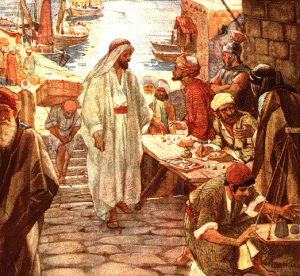
But their response is interesting. They address it, not to Jesus himself, but to the disciples. Their question, “Why do you eat with the tax-gatherers and sinners?”, is designed to appeal to very deep-seated assumptions about what is right and wrong that they can assume the disciples share with them. Their purpose is twofold: with respect to the disciples themselves, it is to try to drive a wedge between them and Jesus. “Do you want to be seen with tax collectors? This is how your Master plans to overthrow the Roman oppressor? By buddying up to their stooges and making friends with those who have already betrayed us to them? Seriously?”
With respect to the overhearing crowd, the Pharisees’ purpose is to discredit Jesus and destroy any credibility he might have as a candidate for Messiah. “How can you follow this guy as Messiah? He eats with tax collectors! Collaborators! He’s not even on the right side in this war.” And they knew their audience well. Their strategy was one that could be expected to be very effective. What they had not reckoned with was the radical genius and the profound theology of their Opponent, who overheard their innuendoes and answered for himself in ways that exposed the shallowness of their hearts and the inadequacy of their assumptions in ways that were most embarrassing. It would not be the last time.
III. THE ANSWER OF THE CHRIST
This is one of those embarrassing moments when you have just made a case that sounds brilliant and irrefutable and impresses your audience most wonderfully—until someone has the audacity to utter one simple sentence that exposes its fatal flaw for all to see and makes it all come crashing down to the ground in utter ruin. Why are you eating [pause for dramatic shock—ooh, gross!] with tax collectors and sinners? What is the matter with you? Answer: “It is not those who are well who need a physician, but those who are sick. I have not come to call the righteous but sinners to repentance.” And your mouth just drops open and you stand there staring stupidly. What can you say in answer to that? The Pharisees were left standing stupefied, but the people who overheard had the opportunity to realize that they were being presented with a concept of what repentance is and how it relates to forgiveness that was radically and profoundly different from anything they had ever heard—and one that made repentance and forgiveness possible for sinners like them.
The Pharisees said if we repent, by which they meant make ourselves worthy, God will send the Messiah. “If all Israel would but repent, then would Messiah come. If all Israel would keep but one Sabbath perfectly, then would Messiah come.” Then Jesus shows up while they are still waiting for that to happen with His own agenda. The Jews said, we must make ourselves worthy, and in response to that, God will send his Messiah to give us the (earthly) kingdom. Jesus said, you simply accept me and I will grant you forgiveness and count it as worthiness of the (heavenly) kingdom. The Jews said, the Messiah comes to save the worthy and judge the unworthy. Jesus said, those who think they are worthy delude themselves, forfeit salvation, and come into judgment–because self-righteousness is the worst form of unrighteousness. I came to save the unworthy, whose primary need is forgiveness, and who know it. And this forgiveness is a free gift granted (as Paul would explain later) by grace alone through faith alone.
 The paralytic on his mat could not perform any of the Rabbinic acts of righteousness to merit forgiveness. Jesus just up and gave it to him out of the blue when he wasn’t even asking for it. He did not say to Levi, “Reform yourself first, clean up your act, and then you can follow me.” He just said, “Come!” And Levi just up and left everything and came, and he was accepted immediately. Now, Levi did become a different man. He started by leaving his sinful employment to follow Christ. But he did this because Christ had already accepted him, not in order to be accepted. And that is the bottom line, the watershed between God’s way of salvation by Grace and man’s way of righteousness by works.
CONCLUSION: The offer of forgiveness reveals Jesus Christ as the One with the right to bestow it–as God. The acceptance of that forgiveness reveals Levi as a saved man. The refusal to admit their need of it reveals the Pharisees as condemned men. And Jesus’ acceptance of that redeemed and forgiven sinner Levi’s hospitality reveals his readiness to accept the worst of us without reservation if we will only turn to him. All this reveals the forgiveness of sins as the heart of Christ’s mission and explains why his path took him inexorably to the Cross. What does your response to it reveal about you?
Note one more thing: Jesus expressed his acceptance of Levi/Matthew’s repentance by table fellowship. It was a profoundly symbolic and meaningful gesture in that culture, and it can be for ours as well, as you might realize if you ever mistakenly tried to sit down at the “cool” table in your high-school cafeteria. Jesus sat down with Levi and broke bread with him and didn’t care whom it scandalized. Do you realize He is still doing that? This same Jesus who accepted Levi’s invitation to break bread together now offers His own invitation to you. We call it the Lord’s Supper. If you can respond to Jesus in repentance and faith and follow Him, it is for you. Come and dine.
Here endeth the Lesson.
Donald T. Williams, PhD, is ordained in the Evangelical Free Church of America, is R. A. Forrest Scholar at Toccoa Falls College, and is a member of University Church, an interdenominational house church in Athens, GA. The author of eleven books and countless articles, he is a border dweller, camped out on the borders between serious scholarship and practical ministry, literature and theology, Narnia and Middle Earth. His latest books are Deeper Magic: The Theology behind the Writings of C. S. Lewis (Baltimore: Square Halo Books, 2016) and “An Encouraging Thought”: The Christian Worldview in the Writings of L. R. R. Tolkien (Cambridge, OH: Christian Publishing House, 2018).

Related