INTERVIEW: WILLIAMS ON TOLKIEN
Christianwriterstoday.com interviewed me on my book An Encouraging Thought: The Cristian Worldview in the Writings of J. R. R. Tolkien, on 2/20/2018. The interview is shared here by permission.
Editor’s note: Dr. Donald T. Williams, the R.A. Forrest Scholar and Professor of English at Toccoa Falls College, has written an insightful new book, An Encouraging Thought: The Christian Worldview in the Writings of J. R. R. Tolkien (Cambridge, OH: Christian Publishing House, 2018). In this interview, Dr. Williams shares some insights about Tolkien and also about his own writing process.
CWT: J.R.R. Tolkien is iconic both among Christians and a wide range of other people. Why does his fantasy world bridge the gap between divergent worldviews?
Williams: I think it captures universal values that appeal to people as human beings: the value of friendship, the beauty of water, wood, and stone, the lure of the quest. It also appeals to something deeper: the need to believe in, or at least find escape in, a world in which light overcomes darkness and hope and meaning are more than wish-fulfillment. That elicits the love of many readers of many backgrounds. What Christians will find in addition is a basis for believing that such things can be more than fantasy, a vision that allows us to find them in the real world and understand why. How Tolkien gives us that is one of the main themes of my book.
CWT: Tolkien had an unusual childhood. How did it influence his writing themes, characters, locations and use of esoteric languages?
Williams: Like Lewis, Tolkien lost his mother at an early age. Her devotion to the Roman Catholic Church inspired Tolkien’s own faith. He was a devout Catholic, but fortunately most of the Christian elements in his fiction will resonate with serious Christians of all denominations. His love of the English countryside is reflected in the Shire. He was fortunate that a classical education informed his love of languages, but that was apparently something inborn. Every writer is influenced by life experiences, especially those from childhood, but genius transcends them all and cannot be explained by them.
CWT: Tolkien allegedly wrote The Hobbit for the private enjoyment of his four children. It was published many years later only because a London publisher heard informally through friends that it existed. Is there a lesson in that for today’s Christian writers? [Who should we be writing for?]
Williams: Perhaps so. The Hobbit was read both to Tolkien’s children as bedtime stories and to the Inklings (the Christian writers’ group that included C. S. Lewis and Charles Williams) for professional critique, and it benefited from both audiences.
CWT: There is a fabled relationship between Tolkien and C.S. Lewis when both were part of The Inklings literary circle. Did they really have a deep and lasting influence on each other?
Williams: They did. Tolkien said that without the encouragement of Lewis and his brother Warnie, he would never have finished The Lord of the Rings. They gave him hope that this (at the time) very strange book might actually find an audience. Diana Pavlac Glyer has written two books on the influence of the Inklings, especially Lewis and Tolkien, on each other: The Company They Keep (Kent, OH: Kent State Univ. Pr., 2007—scholarly) and Bandersnatch (Kent, OH: Black Squirrel Books, 2016—popular). They are the go-to sources for people interested in this topic.
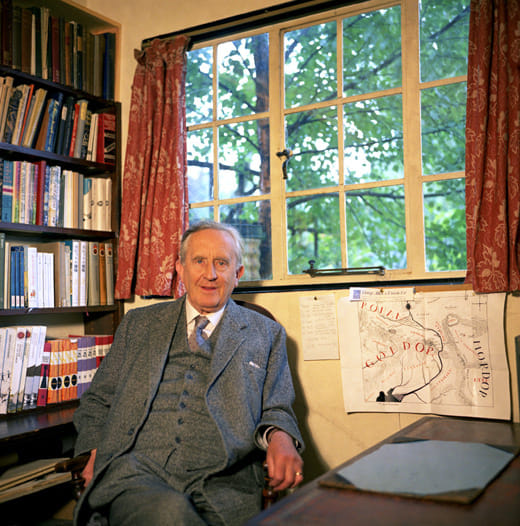 Professor Tolkien in his Study
CWT: How did you go about researching An Encouraging Thought: The Christian Worldview in the Writings of J. R. R. Tolkien?
Williams: I read the Ring Trilogy twice when I discovered it as an upcoming high-school senior in the summer of 1968 and have re-read it almost annually ever since. It inspired me to read every other piece by Tolkien I could get my hands on, and I started taking notes on them and highlighting them even then. His insights into what it means to be created in the image of the Creator became central to my own worldview and provoked many long perambulatory meditations. Thoughts from other Tolkien scholars were added later. So you could say I’ve been working on this book for fifty years! His fantastic vision has been such a set of lenses to help me see the real world more clearly that I have to share it with others.
CWT: You have academic and other responsibilities. How did you find time to write? How long did it take you to complete the book? [Sorry, but aspiring writers are always interested in this pedestrian question.]
Williams: I worked directly on the book in odd moments and in a more sustained way on breaks for only about a year. But that was the culmination of the five decades of preparation I described above. Finding the time was indeed a challenge, but I kept coming back to it because it was not a chore but a labor of love.
CWT: How did your study of Tolkien inspire you in a personal way?
Williams: I was first drawn in by Tolkien’s infectious love of the simple goodness of things like friendship, food, the natural world, starlight, language, story. What kept me a permanent resident of Middle-earth was the rootedness of all of that in Christian truth about creation, man, and Christ. John Donne said, “Learn to see God in everything, and then thou needst not take off thine eye from anything.” Tolkien was one of the first and is still one of the most powerful lenses to show me what living like that actually looks like.
CWT: What is the most helpful advice you can offer aspiring Christian writers based upon your study and experience?
Williams: Find those writers who help you learn to love the right things for the right reasons. Absorb them; digest them. Be patient. Then when the moment comes that you can no longer not write, you will be ready.
Donald T. Williams, An Encouraging Thought: The Christian Worldview in the Writings of J. R. R. Tolkien. Cambridge, OH: Christian Publishing House, 2018, 154 pp., pbk., $11.95. To order it at a discount, go here:
christianpublishers.org/apps/webstore/products/show/7721662
And if this book interests you, you would probably also be interested in Williams’s other recent work, Deeper Magic: The Theology behind the Writings of C. S. Lewis. Baltimore: Square Halo Books, 2016. Order here:
Related