A good book review can perform three services. First, it alerts us to what might be worth our time amongst books coming out now, with description, critique, and evaluation. Second, it lets us comment on issues the book deals with whose significance is ongoing apart from the book itself. Finally, it can have a second life as a signpost to classic works from the past that we might have missed or of which we need to be reminded.
Therefore, I’m going to resurrect some of my old reviews that I think fulfill all these functions. I hope you will be reintroduced to some old friends or helped to find a new one.
Iain H, Murray, Evangelicalism Divided: A Record of Crucial Change in the Years 1950 to 2000. Carlisle, PA: Banner of Truth, 2000, x + 342 pp., hardback.
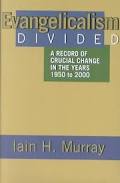
This crucial study, over two decades old now, may be the most important book about the history of the Fundamentalist and Evangelical movements you will ever read. With a richness of primary sources and judicious commentary on them, Murray takes us through the story of the rise of Evangelicalism out of the ashes of Fundamentalism, its efforts to transcend the limitations of its ancestry without losing what was good and right about the original Fundamentalist protest, and its ultimate failure to achieve that terribly needed reform without losing the integrity of its commitment to the biblical Gospel. It is a narrative that explains much about where we are now on the cusp of the third decade of the Twenty-First Century and contains some hard lessons about what will be needed when the faithful remnant of Evangelicals tries to chart its course out of the ashes of that movement.
Murray concentrates on British Evangelicalism, but his study is just as relevant to Bible-believing Christians on the American side of the Atlantic, because the two movements are deeply intertwined by many threads of influence. To give a simplistic summary, British and American Evangelicals had maintained their theological integrity through the 1950s while trying to create new institutions (Fuller Seminary, Christianity Today magazine, The National Association of Evangelicals in the U.S., the Evangelical Alliance in England) that would have a positive witness untainted by the narrowness and legalism of Fundamentalism. But the apparent success of Billy Graham’s 1954 Harringay Crusade in London went to the heads of British Evangelicals, impressed by the influence it seemed to give them with liberals in the established church who wanted to exploit Graham’s popularity for their own purposes. Archbishop of Canterbury Michael Ramsay had told his clergy in the later Greater London Crusade of 1966, “We do not agree with Billy Graham’s theology, but we are using him to build our churches” (55). Evangelicals did not realize how they were being used.
Thinking that Graham’s policy of accepting the support of liberal churchmen and funneling converts to their churches was a path to Evangelical influence in their own denominations, British Evangelicals like John Stott and J. I. Packer naively adopted a stance of cooperation that would eventually lead to more and more compromise, including compromises they themselves neither foresaw nor desired nor accepted. That policy was officially adopted by the Evangelical Party of the Church of England at the Keele conference of 1967. Dr. Martyn Lloyd Jones, foreseeing the problems with that approach, had called for a unity based on the Gospel at the Evangelical Alliance conference of 1966, precipitating a break between the nonconformist Evangelicals and their Anglican counterparts who were committed to trying to see what cooperation could achieve. Subsequent history has proved that Lloyd-Jones was right, given the progressive giving up of point after point by Evangelicals in the Church of England tha followed. Meanwhile, similar dynamics were playing out across the Pond as Fuller’s early commitment to biblical inerrancy because impossible to maintain and the boundaries of what was considered validly Evangelical were pushed outward until they essentially ceased to exist.
Murray shows an irenic spirit unfortunately rare among proponents of separation from liberal churches. I have found the like at the same level only in Francis Schaeffer. He does not rail against Stott and Packer as traitors to the Evangelical cause but evokes sympathy for what they were trying to achieve and appreciation for their many positive contributions to Evangelical life and thought. Nevertheless, he comes clearly down on the side of Lloyd-Jones, who “saw that for Evangelicals to gain ecumenical and denominational acceptance they would have to pay a price which would imperil the very legitimacy of their distinctive beliefs” (45). Murray points out well the dangers of a strong desire for acceptance by the world when it is no longer possible clearly to distinguish between the church and the world.
 Iain H. Murray
One sees this danger of the lust for acceptance clearly not only in denominational struggles but also among Christian academics. The greatest damage done by Christian Anti-Intellectualism may be Christian Pseudo-Intellectualism. When an Evangelical gets to grad school in whatever field, too often his Fundamentalist ancestry makes him pitifully anxious not to appear unreasonable, legalistic, narrow, or obscurantist. The danger then is that at best he does a lot of unnecessarily embarrassing virtue-signaling to cover his insecurities, and at worst he makes compromises he should never have made. This then confirms the bias of the Anti-Intellectuals, who feel justified in digging in their heels and thus producing more and worse Pseudo-Intellectuals as described above. And Satan laughs all the way to the bank.
These lessons from a past generation are ones we would do well to ponder in our own.
Donald T. Williams, PhD, is ordained in the Evangelical Free Church of America, is Professor Emeritus of Toccoa Falls College, and is a member of University Church, an interdenominational house church in Athens, GA. The author of thirteen books and countless articles, he is a border dweller, camped out on the borders between serious scholarship and practical ministry, literature and theology, Narnia and Middle Earth. His latest books include Deeper Magic: The Theology behind the Writings of C. S. Lewis (Baltimore: Square Halo Books, 2016), “An Encouraging Thought”: The Christian Worldview in the Writings of L. R. R. Tolkien (Cambridge, OH: Christian Publishing House, 2018) and Ninety-Five Theses for a New Reformation: A Road Map for Post-Evangelical Christianity (Semper Reformanda Publications, 2021).
Related